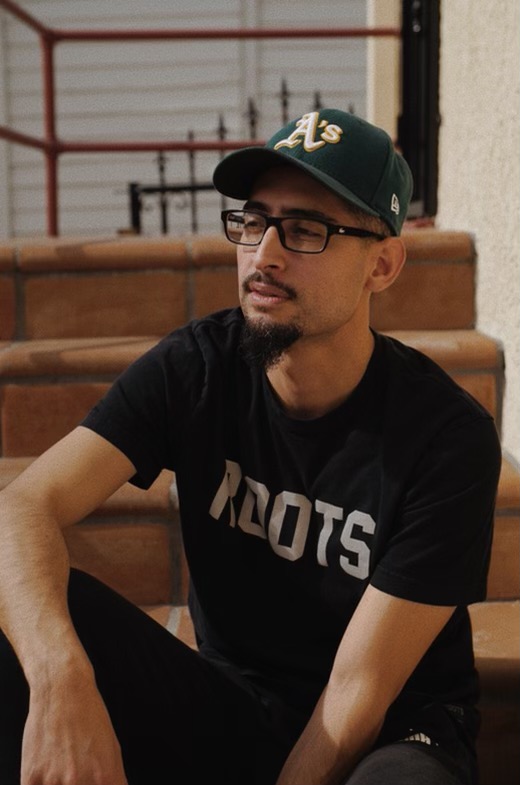
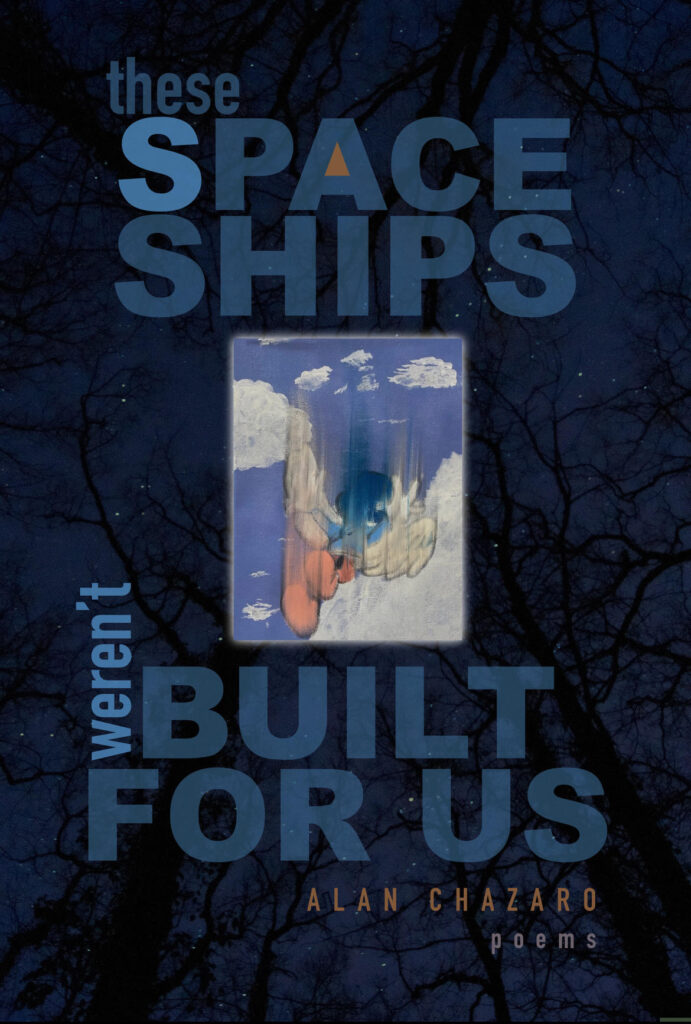
Alan Chazaro is a Mexican American journalist, poet, and author of These Spaceships Weren’t Built for Us (Tia Chucha Press, 2026), This Is Not a Frank Ocean Cover Album (Black Lawrence Press, 2019), Piñata Theory (Black Lawrence Press, 2020) and Notes from the Eastern Span of the Bay Bridge (Ghost City Press, 2021). A graduate of June Jordan’s Poetry for the People program at UC Berkeley and a former Lawrence Ferlinghetti Poetry Fellow at the University of San Francisco, his work has appeared in NPR, The Guardian, GQ, Los Angeles Times, SLAM, and elsewhere. He is currently based in Veracruz.
In July, 2026, I had the pleasure of speaking with Alan Chazaro about his latest poetry collection, These Spaceships Weren’t Built for Us. Our conversation took us from the lasting influence of Bay Area hip hop and car culture, the importance of multidimensional Latino representation, the relationship between place and identity, to the intuitive process behind shaping poems. Throughout our discussion, Chazaro reflected on poetry as a space for reclaiming historically overlooked stories, honoring cultural inheritance, and imagining expansive futures where marginalized communities can exist on their own terms.
This interview has been edited for clarity.
Stephanie Zhang (Zhang): Thank you for taking the time to meet with me to discuss your new poetry collection These Spaceships Weren’t Built for Us. Throughout this collection, music pulses continuously—not only through references to artists like Too $hort, Baby Keem, Outkast, and Tupac, but also through rhythm, repetition, and the pacing of individual poems. Since you’ve also written This Is Not a Frank Ocean Cover Album, I’m curious what draws you to particular songs or artists. What makes a song stay with you long enough that it eventually finds its way into a poem?
Alan Chazaro (Chazaro): A big part of my identity was that I grew up in the San Francisco Bay Area during the ‘90s, immersed in hip hop. There’s a sense of empowerment in hip hop, specifically for young men who have been institutionally marginalized in American society. I was into graffiti—I used to put spray cans in my backpack, hop over fences, and tag walls. There’s a certain liberation in that when you feel invisible in American society as a man of color.
Hip hop can provide a sense of comfort, power, and confidence. I feel that translated through the music. It alchemizes in my spirit, in my mind, and in my heart. My incorporation of those songs, lyrics, and artists is my way of acknowledging that lineage of orality, song-giving, creativity, and individuality. I exist to put my frequency out into the world, and whoever receives it receives it. Hip hop inspired me to do that in a way that no other genre of music has ever done.
Zhang: Another thing I wanted to ask about is: cars appear throughout the collection as recurring characters like your Corolla, Volkswagen, Ford, the black Honda, your brother’s Jetta, even Max’s Mustang. They’re tied to memory, movement, class, and belonging all at once. At what point did you realize these vehicles had become such meaningful objects in your poetry? What were they allowing you to say that another symbol couldn’t?
Chazaro: I grew up with my dad and an older brother, so that meant a lot of sports, rap music, video games, boxing, and cars. I try to include those things in my poems because, when I was growing up, I never read books in school that made me feel like, “That’s how I grew up, too.” It was always stuff that was way flowery or very erudite. My dad had a classic Mustang in the garage, and we worked on it together. There’s something very visceral and important for me in writing what I don’t normally see in poetry.
There’s a huge history of people using cars as a way to reclaim their identity. It’s a symbol of resistance and belonging. Again, that’s what hip hop is. It’s taking and pulling from all of these places: soul music, funk, jazz, and oppression. Similarly, any family might take an old car and build it back up into something drivable and beautiful. There’s a lot of power in that, and when I write about cars and music, it’s honoring those realities and the way they’ve influenced me and so many other kids that grew up like me.
Zhang: In one of your poems called, “An Introduction to American Pathology (Remix),” you note that none of your favorite X-Men characters were Latino (19). I’m interested in what happens when people grow up imagining themselves into stories where they don’t quite exist. Do you think that absence shaped the kinds of literary worlds you wanted to build for yourself—and for future readers?
Chazaro: The tribute in my book is to my son, who will eventually become a future reader. With this book in particular, I wanted to write into a space, literal and figurative, that I don’t see enough of, and that’s speculative Latino fiction—science fiction. It’s on the nerdier side. I like Lord of the Rings. I love Star Wars. I feel like that side of being Mexican American can get suppressed—especially when I was growing up. It was always “Mexicans like soccer” or “Mexicans like boxing” but it was never “You could be a Mexican Pokémon Master.” Not being able to see myself in those spaces made me realize that’s a blind spot. We need to fill that void with literature, with art, with music, with images of people that also like these things. That has all changed with the internet nowadays, but when I was growing up, masculinity as a Mexican American boy felt very rigid in what was presented as socially acceptable.
Breaking out of the box and being multidimensional is essential for me as a writer; and, as a person, as a man, as a father, as an artist, I always try to let the different influences and sides of myself inform one another. This book is my way of letting all of those sides of myself co-exist because, sometimes, they feel very separated and invisible.
Zhang: What’s represented on T.V. seems, more often than not, like stereotypes, which makes cultural identity look performative. I appreciate how your multidimensionality and how you’re breaking past these boundaries and binaries set with the media.
Chazaro: A lot of cultural aspects get flattened and stripped away of their magic. There were many pressures when I was growing up to be something—to be that way. Poetry and hip hop are two mediums that allow me to feel like I’m able to do things in my own way and have a voice.
Zhang: Another recurring theme of this collection is that, as mentioned in “A Portrait of Kevin Durant Leaving the Brooklyn Nets,” “Everything moves fast here” (21). Many of these poems are deeply rooted in the Bay Area, yet you’ve since moved to Veracruz. I’m curious how physical distance changes a poet’s relationship to place. Has writing about California become easier now that you’re farther away from it, or has distance complicated those memories?
Chazaro: It’s a bit of both. Every time I leave California and the Bay Area, I always deepen my appreciation for how unique and diverse California is. California feels like a country in itself. But it’s important to also recognize that California has become unlivable because of the high cost, and many people have been priced out. So it’s good and bad, but, being in Mexico is more about me being in tune with my Mexican side and allowing my son to see the world in a less filtered way. The United States gives you this filter that everything is perfect and idealistic, even if it isn’t. In Mexico, that filter gets removed; you see struggle in more aspects of daily life. It makes me appreciate how rich California is, in every aspect of the word, and that influences how I write about both places.
Zhang: The poetry collection is categorized into “Here,” “There,” and “Gone.” It seems like a linear journey, but, in reality, it’s much more nuanced than that. I’m really glad that you said both in regards to how the distance affected you and your writing.
Chazaro: Definitely. I could get in my car right now and drive back to California if I wanted to, and when I’m in California, I could drive back to Veracruz. That direct connectivity is something that other diasporas lose out on because if you’re from Taiwan or Russia, you can’t just get in your car and drive back. The social and geographical gaps are much wider.
California used to be Mexico and, before that, indigenous lands. There’s this deep ancestral connection that you can’t separate. The Mexican American conundrum is that we have so much that we get to pick and choose about how much we want from both sides without really having to go that far for either. I think that’s a blessing to have that physical, cultural, mental, and spiritual proximity. The countries are close, yet so vastly apart, and I try to explore that in my writing.
Zhang: I also wanted to ask, the poems within this collection are presented in a variety of stanza and line formats. There’s whimsy in the staggered spacing and swaying indentation in “My Mexican Abuela Taught Me How to Land on the Moon,” as if the message is drifting or orbiting. And, in “Space can be interesting without being an astronaut,” you utilize forward slashes to signify the beginning of the next line. It’s very fun and self-referential. At what point in your drafting process do these visual decisions emerge? Are they intuitive discoveries, or do they come after the poem already exists?
Chazaro: Poetry is my favorite genre because it’s freeing and there’s so much room for intuition to blend with ideation. I’m allowing these memories and textures and sounds and vibrations to channel themselves. They take their own shape, and I trust that it has a meaning and a purpose. I had a professor named Bruce Snider in graduate school at the University of San Francisco, and he used to have us do formal exercises with line breaks. His instruction opened a world of exploration through lines, line breaks, lineation, and the infinite possibilities. When I write as a journalist, it’s very structured, it’s very formal and literal. There are rules and expectations. But when I go to poetry, it’s freestyling.
Zhang: The way you describe your methods seems like you’re a mad genius, but at the same time, I know that this has been curated for years and years with practice.
Chazaro: I’m definitely not a genius! When I’m drafting, there is a certain level of polishing. However, as a poet, I do try to honor “this is how it came out,” and I’m going to run with that with a few minor alterations along the way because, if not, you can get stuck in a loop of “does this feel perfect?” or “is this right?” Poetry isn’t about being right. For me, it’s about being present and honest within that moment.
Once I learned to let go of that sense of perfection in a poem, it became an out-of-body thing. I used to get that feeling when I did graffiti, too. You don’t feel present; time erases. I could spend four hours working on a poem, and it feels like five minutes because I’m so entranced by the process. Tongo Eisen-Martin, the former San Francisco poet laureate, is a friend of mine, and he once told me that his happy place as a writer is when he becomes hypnotized by his own words as he’s reading them aloud. It’s a state of euphoria all writers aspire to reach, I think.
Zhang: I hope I can get to that level. There’s an especially compelling line in “No One Has Ever Told Me To Go Back to My Planet, But If They Did, I’d Roll Up My Space Hoopty’s Windows and Listen to “M.E.T.H.O.D. Man”: “We all shared this soundtrack: pochos, Chinitos, Filipinos— // immigrant families near the Bay’s shoreline” (50). That moment feels deeply rooted in a particular community while still inviting readers from outside it. When you’re writing, do you imagine a particular audience, or do you avoid thinking about readers until the work is finished?
Chazaro: I always write essentially for myself, and, in doing that, I’m writing for many versions of myself. I also try to remember the kids who need literature they can connect to. They need music, they need art that makes them feel seen. When you can write for yourself in that way, there’s always going to be somebody else who feels similarly in whatever shape or form. In a way, you’re writing for them, too. So I am writing for those versions of myself and all of the people who might relate to that.
Zhang: Throughout the collection, the spaceship becomes more than a means of escape. It gradually comes to represent inheritance, imagination, and collective survival. Your hardworking father, your wise abuela, and so many others before you helped build the foundation for that journey. How does the beautiful space oasis of paleteros that you envision in these poems relate to the future your ancestors hoped for? Where do those visions overlap, and where do they differ?
Chazaro: It comes back to that idea of writing for myself in order to create space for other people. It’s a positive ripple. The Bay Area is the home of the Black Panthers, the home of the hippies, the home of the Free Speech Movement. To me, it is one of the most whole-hearted, politically-minded, diverse, inclusive territories on the planet. I grew up with friends from all over the world, with all kinds of life circumstances, and that made me very conscious from a young age.
The ongoing lineage of art is that I permanently put my truth out into the world, and that energy gets received and transformed through another person. My community in the Bay Area gave me that awareness, and now I’m trying to give it back out to the universe. To be a part of that is a blessing and I am always grateful to be writing every day.
Zhang: From what it sounds like, the Bay Area is a place where you can’t help but start off as an observer. And then, as you’ve said, you become the change you want to see.
Chazaro: For sure. Everybody’s allowed to vibe at their own frequency and you’re invited to join, but if you don’t want to, it’s totally cool too. In the Bay Area, it’s more, “Be yourself, and that’s enough.” When we can reach that state, it’s really freeing.
Zhang: Thank you so much for speaking with me today.
Chazaro: Thank you for hitting me up. I really appreciate it. It was fun.
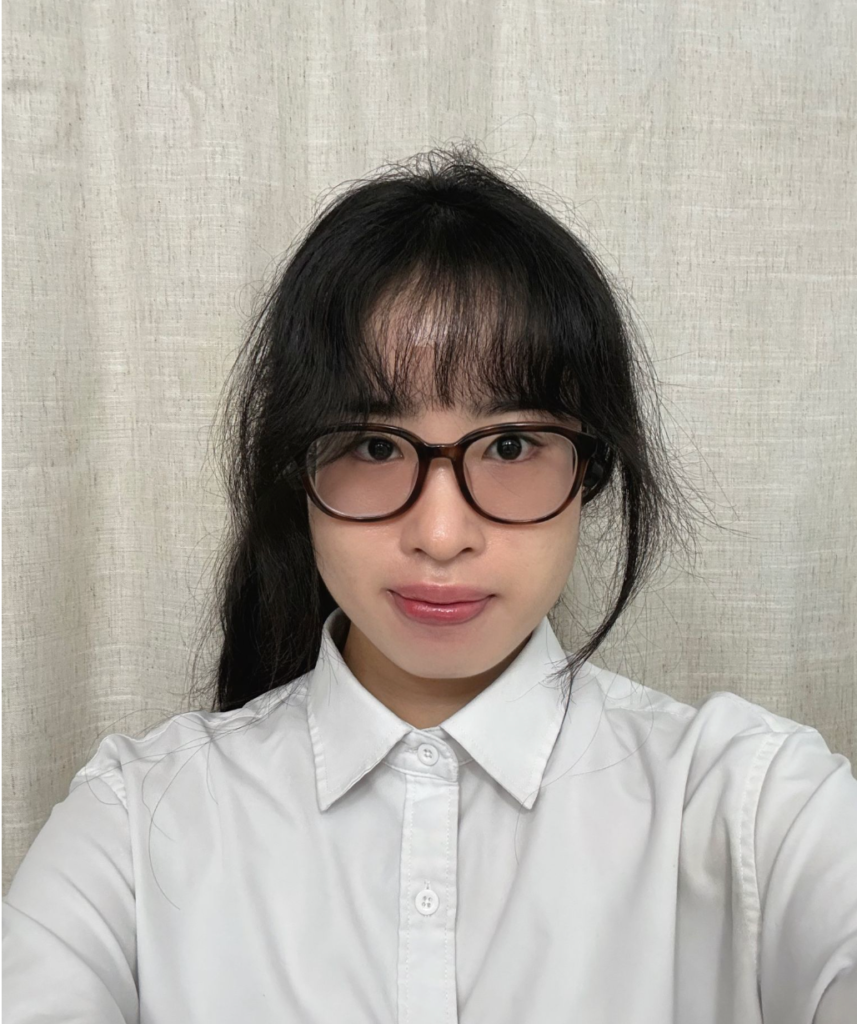
Stephanie Zhang is a Hawai‘i-born Cantonese writer and undergraduate student in English and Second Language Studies at the University of Hawai‘i at Mānoa. Her literary research explores the crossroads of gender, sexuality, power, and representation across a wide range of modern literature and visual media. As a bilingual speaker of English and Cantonese, Zhang is also interested in language as a site of identity formation, community-building, and cultural expression. Her research in Second Language Studies focuses on bilingualism, code-switching, and the Complementarity Principle. Across both her scholarly and creative work, she is drawn to questions of transformation, curiosity, and personhood.


Leave a Reply