
By Ryan Yamauchi
The Hyakki Yagyō, Japan’s fabled march of one hundred demons, has long been a subject of interest to scholars and everyday people alike. The march is a special moment in which those mystic beings that exist along the boundaries of human understanding are free to roam the earth. In The Night Parade: A Speculative Memoir, Jami Nakamura Lin writes from the borderlands between our world and the world of these mystic beings, capturing moments from her life that seem to wander and weave atwix the two. At its heart, this book is a meditation on trauma. Navigating pain and sorrow, Lin writes on her struggles with bipolar disorder, childbirth, and loss, recounting them as a tale for the reader to experience.
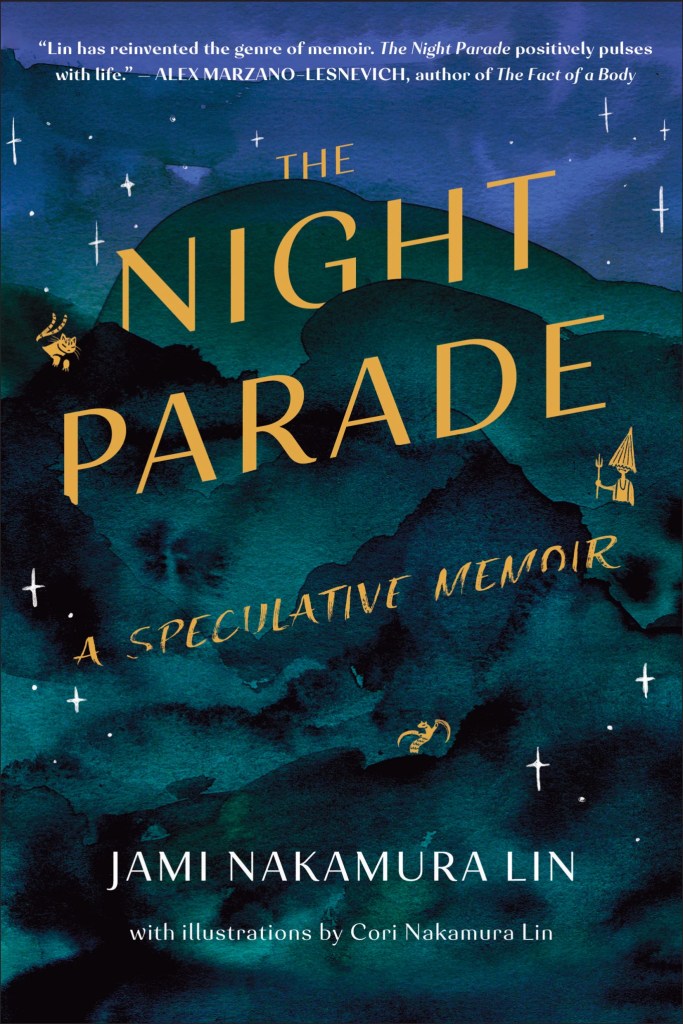
Using the East Asian narrative structure of kishōtenketsu as a framework, Lin delves into the history of yōkai (supernatural entities that are everything from gods to demons), looking to find the original tale of these paranormal beings. The four-part structure sets up a narrative that is cellular in nature. In each of the four sections (Ki or beginning, Shō or development, Ten or twist, and Ketsu or conclusion), Lin examines yōkai and other mythic entities that have strong connections to her life and experiences: rage-driven oni-baba cursed for their anger, kitsune known to possess unsuspecting humans, and the elusive baku that consume painful nightmares. These are only a few of the fantastic creatures found in this memoir. By exploring these creatures’ histories, Lin strives to understand her own.
Lin starts her tale in Japan, an outsider to the culture, on the search for the mythical kappa. As she pores over past studies and explores the village of Tōno, the “cradle of Japanese folklore,” Lin starts to recall her past, trying to pin down exactly when her own story begins. From here it becomes apparent that the origin of any being, supernatural or otherwise, is not so easy to ascertain. Just as her search for the kappa falls short, Lin’s writing is often disconnected and sporadic, struggling to make solid connections between two points in her life.
Yet Lin’s seemingly disparate networks of stories and events form a grand image, highlighting the very beauty of The Night Parade. Everything in it is meticulously crafted, each loose end a necessity, each leap of reasoning also one of faith, and each creature examined essential to an end that can never truly come. The Night Parade is extraordinary as it is not a typical memoir. It does not strive to encapsulate a life’s struggles in a neat timeline. Fittingly so, as no life truly lived is ever neat. Lin writes, “In the presence of a story—if the story is a good one—time collapses.” With her work, Lin whisks the reader on a journey that covers decades of reflection and contemplation to create a tapestry that tells her life, not as a tragedy, but as folklore.

In doing so, Lin makes the unfathomable approachable. What I found most remarkable was how easy it was to fall into Lin’s writing. The weight of illness and loss are not diminished in The Night Parade as they hang over every moment. This pervasive gravity in the memoir, the sense that there is always something hanging over Jami’s shoulder, perfectly captures how our fear of the unknown plays a heavy role in our perception of the supernatural, just as it affects how we view sickness and death. By connecting her life with the Hyakki Yagyō, Lin allows the reader to see themselves walking in that march. Quite often, I would find myself contemplating how these creatures emerge in my own life, checking the nooks and crannies of my own memory for the elusive yōkai that hover just outside my vision.
The chapter in The Night Parade that will stick with me the most is the section on bakekujira, the ghost whales that haunt their killers as vengeance. These skeletal whales would curse the villages that hunted and feasted on them, bringing calamity not only to the killer but to the entire community around the culprit. Lin writes that the only way to appease these apparitions would be to “bury the whales’ bones or place them standing up, create gravestones, and conduct funeral rites, praying for the souls of the whales to rest in peace.” These bakekujira, in part, are symbols of the past. They represent the crimes of humans coming back to haunt us. This chapter allowed me to think back to my youth; back to a time when I let my own fury to flow through me. When I acted and spoke to hurt. The bakekujira do not vanish when forgotten. They are settled when they are remembered. They forgive when they are respected.
Here is the magic of Lin’s writing. The ties she creates between humans and yōkai reveal powerful truths about the nature of horror, fear, and isolation for all of us. More than that, however, she reveals what it takes to heal. In some sense, yōkai are manifestations of our own uncertainties. They are always there, whether we can see them or not. They are our rage, our sadnesses, our traumas. They are what we turn into if we forget where they come from. They are what we become when we forget we are never truly alone. For binding these worlds together, I cannot praise The Night Parade enough.
To only say the very least, The Night Parade is also a bold reimagining of the memoir genre. The autofictional blend of folklore and biography creates a fantastically unique experience that simultaneously engages and develops what a memoir can be. The multifaceted, weaving style of the story, the open-endedness of kishōtenketsu, the reflective nature of myths, all combine their paces to march the genre onward.
But more than anything else, Lin’s reminder, that building shrines to the past is perfectly acceptable, will always linger. Sometimes it is the only way to move forward.
Ryan Yamauchi is a recent graduate of the University of Hawaiʻi at Mānoa. He currently works as a teacher and writes in any free time he can find. Some of his passions are playing video games, watching movies, and finding new hobbies to experiment with. One of his greatest ambitions is to publish a science-fiction novel. Currently, he is looking to publish his short stories and is training to teach English abroad.
 MĀNOA
MĀNOA 
Leave a comment