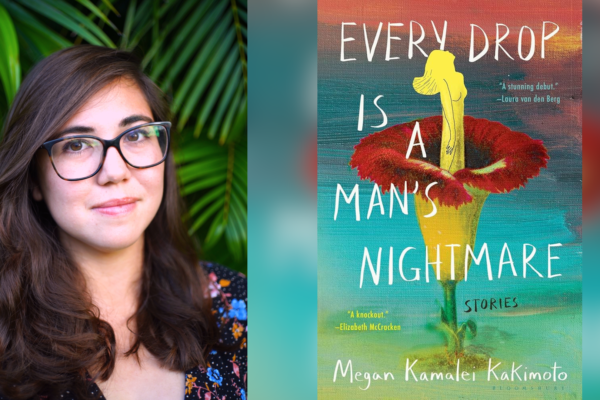
Megan Kamalei Kakimoto is the Japanese and Kanaka Maoli author of the story collection Every Drop Is a Man’s Nightmare (Bloomsbury 2023), a USA Today national bestseller. Her work has appeared or is forthcoming in The New York Times, The Guardian, Granta, Joyland, and elsewhere. Named a Fall 2023 “Writer to Watch” by Publisher’s Weekly, she has received the “Author Under 35” Award by the HONOLULU Book Awards and has been a finalist for the Keene Prize for Literature. Her work has been supported by the Rona Jaffe Foundation, the Bread Loaf Writers’ Conference, and the Tin House Winter Workshop. She received her MFA from the Michener Center for Writers and is an Affiliate Faculty in Fiction at Antioch University Los Angeles and a Lecturer in English at the University of Hawaiʻi at Mānoa. A Fiction Editor for No Tokens journal, she lives in Honolulu.
In December of 2025, I had the honour of speaking with Megan Kamalei Kakimoto amidst the semester-closing bustle. Our conversation moved through her appointment as Writer In Residence with English at UH Mānoa, her acclaimed collection Every Drop Is a Man’s Nightmare, the pull of writing toward our obsessions, and the layered complexities of writing in, from, and about Hawaiʻi. The haunting prose in Megan’s work is rooted in the intention of crafting narrative spaces where Kānaka identities are able to unfold on their own terms, guided and shaped by ancestral memory and connection to ʻāina. It was a true joy to have shared this conversation with Megan!
This interview has been edited for clarity.
Siobhan Ting (ST): I wanted to start by congratulating you on your appointment as writer in residence at the University of Hawaiʻi at Mānoa (UHM) English Department for Spring 2026. Everyone is so excited to have you!
Megan Kamalei Kakimoto (MKK): Thank you!
ST: Your appointment as writer-in-residence will entail working with many students writing in, from, and about Hawaiʻi. From your experience with the publication of Every Drop is a Man’s Nightmare, what has most affected your pedagogy, especially in terms of marketing and reception? What would you relay to students who are writing in Hawaiʻi?
MKK: The experience of putting a book out into the world is so different from writing the book—just the idea of the book becoming an object for public consumption. You are putting forth a sense of your own vulnerabilities.
I take a lot of responsibility in crafting stories—in crafting this collection—and wanting to honor my ancestry, my heritage, and the stories I grew up with. I made it a point to ensure that I had very clear intentions about what I was doing with my work. I tried to put meaning into my work with these intentions in mind, while also knowing it’s the reader’s job to find that meaning and do that meaning-making work.
Once the book was out into the world, I had a lot of understandable anxiety around its reception. But at some point, I started to feel more at peace knowing it’s in the world, and that’s a huge gift to me. It felt like something I really wanted to do, and I was proud of it. Once the book is out into the world, I can’t fully control how it’s going to be received, what I felt like I was able to control were the choices I made on the page.
Beyond the process of putting it into the world—the marketing and publicity—what was important before that was clarifying my intentions for myself and then with the people who were supporting the book. Thinking about my agent, my editor, as well as the marketing and publicity teams, and ensuring we were all on the same page and making that clear. In terms of how I would approach talking about this with students, something that’s essential for me to convey to writers is the need to do the hard work of asking after your intentions, and being able to stand by the choices you’re making on the page. As long as you can do that, you’ll be able to talk about your book. You’ll be able to find that peace once it’s out into the world, knowing that you’ve made the decisions you’ve needed to make on the page.
ST: Was there a noticeable difference between marketing the book in Hawaiʻi and marketing it elsewhere?
MKK: Honestly, it’s tough to talk about because there’s so much pressure both ways in terms of thinking about the book being marketed in Hawaiʻi versus elsewhere. My main goal when putting this book out there was wanting to do justice not only to the stories, the characters, and the world that I had been writing into, but also to the inheritance of storytelling. What that meant for me was doing justice to this community of writers—of art makers—in Hawaiʻi whom I have been so fortunate to learn from and who had brought me up. So, when I thought about what the marketing would look like, I wanted to do right by these people and by my inheritance—my ancestral inheritance of storytelling.
Once the book was actually in the world, and once I was doing readings here and meeting students and writers, I found so much joy in the reception. The sentiments that most touched me when I was meeting these writers and readers was that people felt seen, that they felt like their upbringing, their lives, their ancestral stories—they were seeing all of that in the page. That was a huge gift to me because that had been what I’d wanted to accomplish with these stories. And it was the same when I was touring across the Continent: I had met other writers and readers of the Hawaiian diaspora who I hadn’t known before, and we were able to connect in a place that was not Hawaiʻi; being able to connect in that way was truly special.
ST: That’s beautiful! I was also interested in the idea of place-based writing, specifically because in Hawaiʻi intimate relations with ʻāina is such a central tenet. Did you face any challenges writing about place and representing Hawaiʻi, which were maybe similar to the challenges you faced writing about moʻolelo and the Hawaiian experience?
MKK: I think about place constantly and that was absolutely a central piece in the collection. One thing that also comes to mind is thinking about time, and the time it took to write these stories. A few of these stories were with me for seven years, so I have such a long relationship with them. I started a few of them while I was living here in Makiki, others when I was in Austin, in grad school, craving home and missing home so deeply. So, my relationship to each story is absolutely founded on where I was in space, and that seeped into all of the stories in different ways that I will probably never fully know. Almost like the magic of creation. [laughs]
What I ultimately hoped for when writing place was to capture exactly what you’re talking about in your question—this intimate relationship between humans and ʻāina, and all creation. I wanted to champion and underscore the knowledge that we come from land, land feeds us, we feed land; it’s this mutual reciprocal relationship in which there is no hierarchy, or there shouldn’t be. I looked for more small ways to subvert and resist a more Western grasp of place as backdrop or place as character. Ensuring that place gets its due was definitely important to me.
ST: You mention carrying out a subversion and resistance through awareness. You’ve spoken a lot about being cognizant of not playing into the “mythical idealisation” of Hawaiʻi as “paradise” in this collection. Were there any specific processes or questions of craft that played a part in carrying out this awareness when thinking about place, like memory or site visits?
MKK: Thinking specifically about craft, detail was crucial when I was writing the stories. I’ve very much come to terms with the fact that I am an overwriter, and I will always be an overwriter. I have to write really messy, unwieldy, disorganised first drafts. For me, that involves something like writing ten descriptive ways of saying one thing, and then paring it down, paring it down, paring it down. But precision of detail is indispensable, and honoring our ability to write place was something I thought extensively about.
Writing against a fetishized image of Hawaiʻi, I was conscientious about what I was doing on the page in terms of how it would be received by readers. Pushing that even further, I was also cognizant of honoring the characters in the story; for instance, making choices on the page that would reflect the emotional honesty of whatever my protagonist was relating to or how my protagonist would engage with ʻāina, history, and family. It was definitely a character-driven process for me.
ST: It’s so fascinating hearing how you engage with detail! You mentioned that a few of these stories were with you for seven years. I’m curious what the oldest and youngest stories in the collection are, and if writing one story ever led you to go back to amend a story you had written previously?
MKK: Oh, I love that question! The oldest story is “Temporary Dwellers” that I wrote several years before it was published in 2018 or 2019. That story, for me, is what the whole collection hinges on, which is kind of wild because I might have left it out at some point in the submission process. I didn’t think it had a place in this collection. But my agent, who is my genius and I adore her, said, “No, this is the story. This is the piece.” And everything built up from there.
I don’t know the most recent story exactly. I do know that one of the more recent stories is the last story in the collection, “The Love and Decline of the Corpse Flower.” This story stands out because it came to me the quickest; it almost felt like it was driving me and haunting me in a way, and it required very few rewrites and revisions.
ST: I’m so glad you brought up “Aiko, the Writer!” You mentioned in your essay on Guardian that designing the character Aiko was one way for you to grapple with doubts about relaying sacred parts of Hawaiʻi like moʻolelo to non-native or white audiences. Could you speak more about your craft in terms of working through uncertainties in representing culture? What was it like to write a fictitious story about someone so similar to yourself, having the same ʻaumākua and heritage? Was it easier or harder to write someone whose story is meant to parallel yours in certain ways?
MKK: I feel like I thought it would be easier than it actually was. I started writing “Aiko, the Writer” truly as a means to have some sort of catharsis because that story felt like it was taking so much of me for so long. But looking back in the writing of it, it was neither cathartic nor particularly easy, [laughs] which might have to do with the fact that it took so long that my relationship with that story shifted so many times.
I also think you’re exactly right: Writing that story required grappling with questions that were distinct to that story, but it also evolved into being relevant to all the stories in the collection; it required me to think about audience. When I write the first draft—even the first few drafts—I’m actively trying to follow the characters, the stories, and the questions, and I’m trying not to think about anyone ever reading it. But from the start of rewriting “Aiko, the Writer,” I realized I had to confront the question of readership almost right away, and maybe the immediacy of that question made it much more difficult to write.
The superstition of the Night Marchers is fairly well known in Hawaiʻi. Everyone has a very different experience with it, and there are also layers of personal understanding. I tried very hard in all of the stories to touch on moʻolelo that is not just huakaʻi pō, but across the board—all of these stories that I inherited from my Grams. And I thought deeply about the balance of how to write it—what to share, what to withhold. It often came down to very specific instances on the level of the line.
One part of the process is very character driven—trying to honor what would be most appropriate for that particular story and character. Another part of the process is grappling with the challenge of writing into what outside perspectives might articulate as a very monolithic Hawaiian experience, which I feel is a result of there not being enough Native Hawaiian writers and storytellers being traditionally published or championed on this platform. So, I really wanted to approach it from the perspective that I’m only offering these stories from what I can offer. I’m bringing my voice—my communal voice—both in terms of thinking about the ancestry of storytelling as one experience, one story among many, and hoping to invite more writers and people to share their own stories.
ST: That’s beautiful. When I was going through these questions, I spoke to a friend of mine who’s also a Native Hawaiian writer, and she mentioned wrestling with the idea of representation due to a fear of the white gaze. You spoke about the white gaze and in your interview with Flux, where you also mentioned that you were interested in exploring women’s bodies, the intersection of Native women’s bodies and the wounds of colonization. You also said, which truly struck me, that you wanted to afford them a range of responses to their circumstances. In that vein, I noticed many of the stories in the collections featured Kānaka women in relationships with neglectful or abusive men. I was wondering why you think this element threaded its way through the stories?
MKK: That’s super perceptive. It’s something I’ve witnessed far too often in our community that I felt I needed to capture, that the stories were demanding to capture. At the same time, it’s writing as a means of resisting erasure, and writing to emphasize our own humanity and the many ways that we exist, that we persist. I wanted to capture that multiplicity of experiences, and doing so demanded confronting challenging topics and difficult experiences that nonetheless deserve to be told and have their space on the page.
ST: You talked about haunting earlier, and it seems like these issues are, in a way, haunting the Islands but not really talked about.
MKK: Definitely! When I’m teaching, I often talk with my writers at Antioch about writing into our obsessions. I love thinking about writerly obsessions, about returning to the same questions, ideas, and curiosities over and over again as a means of embracing our obsessions. Hauntings are actually something that I’ve been working through in the last year: What is haunting you beyond obsession? What is haunting you to the point where you are compelled to write? Follow a thread to a question mark. You don’t know where it’s leading you, but you can’t help following it. That is such a great capture of the haunting thing that drives you to the page.
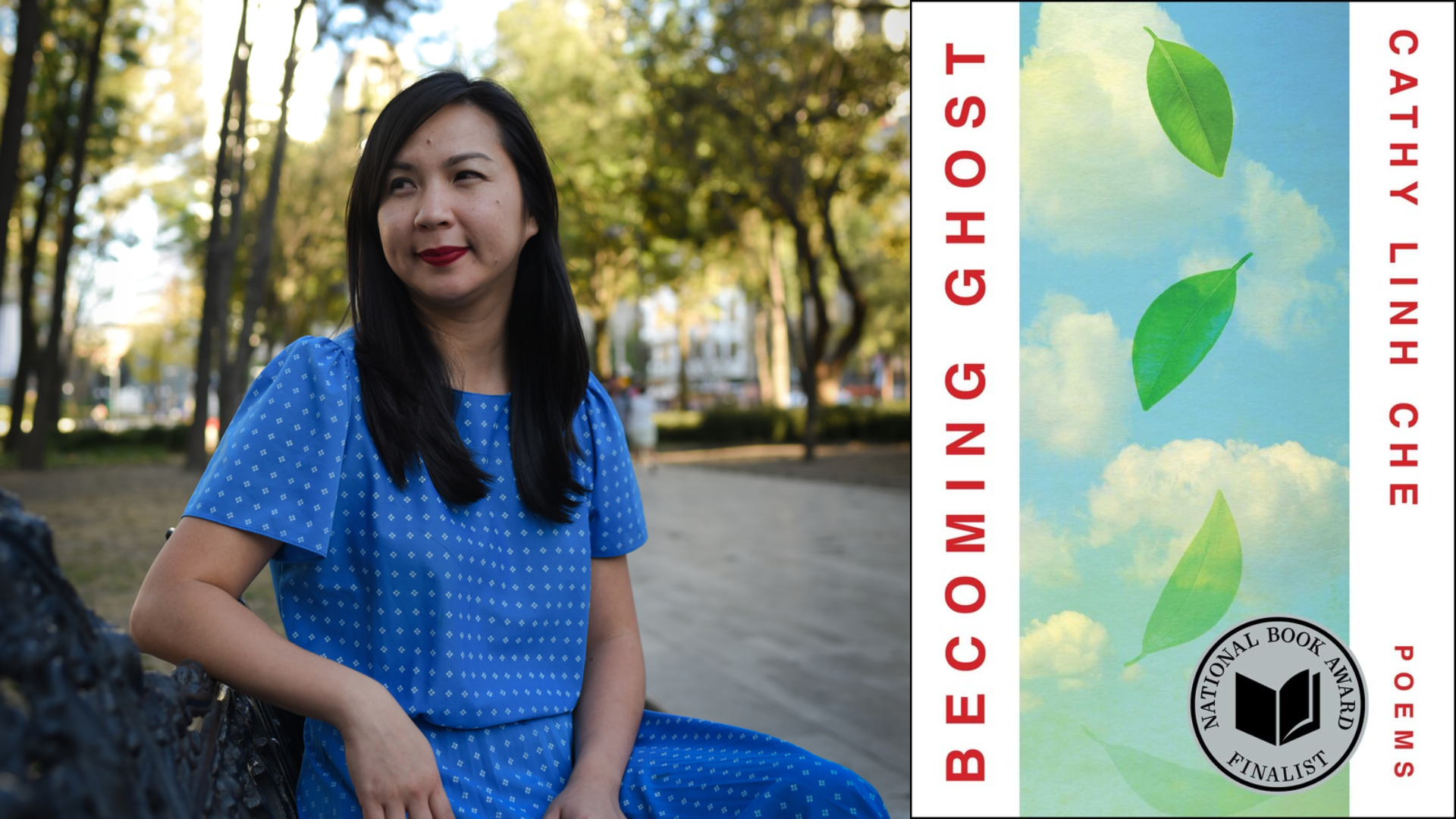
ST: It’s strange because everyone around me has been drawn to the idea of hauntings recently. Our recent guest Cathy Linh Che—I think her presence and work has been haunting all of us!
MKK: Yes, Cathy! And now she’s off and we’re like, What do we do? I feel that. [laughs]
ST: You also speak a lot about your grandmother’s influence in your stories. And, inspired by Cathy’s work, I was wondering if something like channeling or séances has helped you in terms of memory in these stories?
MKK: The 5th—December 5th—was actually my Grams’s anniversary of her passing. So I’ve actually been thinking about timing. Wow. I’ve been thinking about her a lot in these last few weeks. Yes, I absolutely felt her spirit and her influence in a lot of these stories, in the process of writing it. Especially during the revision process while making decisions that are very specific to, for instance, the way someone talks, I felt her coming through on the page. It’s such a gift, but it’s also such a challenge. You mention memory, which makes me think about preservation, and while you can’t actually preserve a singular voice in a singular person, I find a lot of beauty in the act of trying.
ST: I love that! I was also drawn to what you said about following a thread to a question mark, which made me think of this line in “Aiko, The Writer” where you write, “Mostly, none of Aiko’s stories close in a clean, pretty, satisfying package.” Is this something you find to be true of your stories? How do you tend to end a story or how do you know you’ve reached the end of a story?
MKK: Oh, that’s such a tough question! My approach to ending a story certainly varies depending on the story. My favorite stories to read are the ones that feel like they have a life beyond the end, beyond the final word. I love the process of imagining alongside the writer. Because of that, I tend to gravitate toward the same mode of storytelling as a writer myself.
There are also projects where I do actually need some idea of an ending to write toward, and this has actually come forth a lot more in the novel I’m currently working on. Like Every Drop is a Man’s Nightmare, this novel has taken seven years as well! [laughs] Seven plus, actually, since the process hasn’t ended yet! While writing this novel in particular, I’ve been struck by the realization that I need to have a spirit of an ending in mind. At first, it was a strange image that I couldn’t get out of my head. And then, it was a line—a final line—that made me go, “This is the last line.” Then you get to it and you realize, “No, it’s not.” Having something to write toward has helped immensely in crafting this piece.
ST: What advice do you have for up and coming or aspiring writers who are Native Hawaiian?
MKK: Cherish your voice and truly, truly know how vital your voice is. Now more than ever, with the rise of GenAI and in our current political climate, it feels like stories are being reduced to nothing and devalued in every way possible. It’s vital to know that you have a story to tell even if you feel like you don’t, especially for ʻŌiwi writers, because we come from an ancestral inheritance. One of the core tenets of my own pedagogy is emphasizing that I don’t exist as just me, as Megan the writer, but that I bring my ancestors with me in my community. As a writer, I believe that I’m not just myself: I’m the ancestors who brought me here, I’m one among my community. And it’s this collective of voices that I’m bringing forth. The same goes for the writers that I’ll have the privilege to work with at UHM. Your voice is indispensable. Cherish it and know that it is vital.
ST: As you mentioned, it’s a really difficult time now to be your writer. Are there any ways that you take care of yourself?
MKK: I take care of myself, honestly, through reading. I feel like I became a writer and came to writing through a love of reading. As an educator, with time becoming less and less, I’m often turning to writers who inspire me with the time I do have! I have Noʻu Revilla’s Ask the Brindled on this side of my desk, and I have Isabella Hammad’s novel Enter Ghost on this side of my desk. I really anchor my life around reading.
Walking my dog also brings me great joy and peace. And hiking! Hiking is another thing I do to try and take care of myself.
ST: To end, who are you currently in community with? Have you been attending any local literary events?
MKK: Mixing Innovative Arts (MIA)!
ST: Oh yes, MIA!
MKK: I’m so excited about the return of MIA! I also have the great fortune of being co-chairs for Kundiman, the Hawaiʻi regional group, alongside Joseph Han. We hope to host quarterly events like readings, salon-style readings, in 2026! It’s a great community. I also work as a bookseller at Da Shop in Kaimuki, so I have the privilege of being able to do all the setup for the many events they hold! That’s an amazing space as well!
ST: This has been wonderful! Thank you so much!

Siobhan Ting is a Chinese Malaysian writer and MA student in English at the University of Hawaiʻi at Mānoa. Informed by her upbringing in Malaysia and her experience as an immigrant and a settler in the Hawaiian Kingdom, her work tends towards marginalised literatures and explorations of how imperial histories, globalisation, and migration influence cultural identity. She is currently working on a braided essay on the affordances of Malaysian Literature in English to foster identity beyond a nationalistic register.