Viet Nam
Editors Robert Shapard and Frank Stewart.
Guest Editors Kevin Bowen and Nguyen Nguyet Cam.
The winter 1995 issue features fiction and poetry by nine Vietnamese writers in new translations. Guest-edited by Vietnamese Nguyen Nguyet Cam and American Kevin Bowen, the feature presents some of Viet Nam’s most distinguished writers and well as some of its youngest.
The poems gathered here by Bowen range from those of soldier poets in their fifties and sixties, writing about suffering and endurance, to the numinous lyrics of Nguyen Quyen, born after the war and now in his early twenties. Also here is an interview by Bowen with Nguyen Ngoc, one of Viet Nam’s best-known writers and intellectuals, on the past and future of Vietnamese literature.
Along with contemporary Vietnamese stories and poems is a selection of Vietnamese folk poems, or ca dao. The tradition of oral song-poems goes back as far as the Vietnamese language itself. As translator Linh Dinh says, ca dao are the true cultural heirlooms of the Vietnamese people.
The other works of fiction in this issue are set in places as far apart as the Netherlands, Samoa, and the Philippines, and are shaped by personal and societal myths. There is fiction about Tibet by Chinese writers Ma Jian and Ma Yuan; and the American fiction, poetry, and essays are by Gordon Lish, Leonard Nathan, Stephen Lyons, Debra Dean, and others.
The essays consist of meditations on landscape and natural history, memories of childhood in the American Northwest, and reflections on the troubled U.S. of the 1960s.
About the guest editors: Nguyen Nguyet Cam was born in Ha Noi in 1970. She graduated in English from Ha Noi University and has translated numerous works from English to Vietnamese, and from Vietnamese to English. She is an assistant to the resident director of the Council on International Education Exchange in Ha Noi.
Kevin Bowen is director of the William Joiner Center for the Study of War and Social Consequences at the University of Massachusetts at Boston. He served in the U.S. Army from 1968 to 1969 and has returned to Viet Nam many times since to initiate exchange and assistance programs. His writing has appeared in American Poetry Review, Agni, Boston Review, Ohio Review, Ploughshares, Prairie Schooner, and TriQuarterly, among other places.
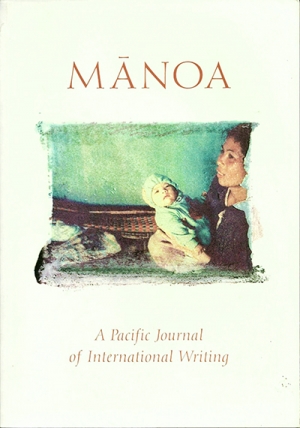
Muriel Fujii, a photographer and teacher living in Honolulu, contributed the photos for this issue. The cover photo was taken by Denise Rocco.
Extracts
“I joined the army . . . traveling far from
my village many years,
the old river with one bank crumbling,
one bank built up.
I found my love for my grandmother too late,
a grassy mound all that was left.”
—from “Do Len” by Nguyen Duy
“They smiled toward me, untied the gunnysack, and she appeared, arms and legs tied up in front of her chest with a cord, like a newborn baby. A Buddhist insignia was cut on her back with a knife. The slit skin was already dried and shrunken. As soon as they cut the cord, she tumbled down onto the earth. They arranged her head and pulled her arms and legs out straight. Now she lay face upward, looking at the sky and and the scattered wisps of fog. The younger brother had already scattered some roast barley and lit a pile of incense sticks. The thick smoke mixed quickly into the fog. Propped over another fire was a pot in which the younger brother melted butter. The elder brother added some dung to the three piles of burning incense and looked up at the peak. The lama was already sitting crosslegged on a sheepskin near the fire, his scriptures open, both hands telling his prayer beads.”
—from “Woman in Blue” by Ma Jian
“Stampari also tells us that, crouched at the poet’s knee, was a slave boy who could whistle to perfection the song of any bird that came to drink or bathe in the waters of the fountain on whose steps the poet sat every day, all day. The boy was otherwise mute, his tongue cut out by the pirates who sold him to the poet. Listening to the boy’s imitation of a song, Abu would promptly create from it a poetic bird more vivid, more alive, more whole than the original.”
—from “Paths of the Snow Bunting: Towards a Poetics of Bird-watching” by Leonard Nathan
248 pp., fall 1995 (7:2), $20
ISSN 1045-7909
JSTOR
 MĀNOA
MĀNOA 