Tyranny Lessons: International Prose, Poetry, and Performance
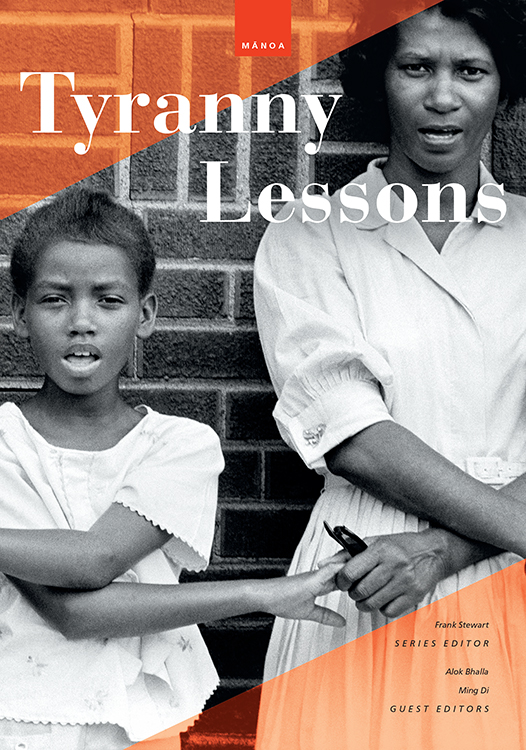
Guest-edited by Alok Bhalla and Ming Di.
Series Editor Frank Stewart.
In Tyranny Lessons: International Prose, Poetry, and Performance, outstanding international authors address the rise of social intolerance, racial injustice, and political despotism. In their passionate prose, poetry, essays, and drama, these contemporary writers speak to the experiences and struggles of ordinary people against the restrictions on their lives, movements, and thoughts imposed by illiberal democracies, failed states, discriminatory communities, and coercive relationships. Their stories of survival and resilience are indispensable lessons in a troubled time.
Included are new translations of outstanding writers in China, Croatia, the Czech Republic, Estonia, France, Hong Kong, India, Indonesia, Ireland, Latvia, Slovenia, Syria, Taiwan, Tibet, and Turkey, plus work by U.S. writers.
American writer Walter White depicts the history of violence and segregation in the U.S. As a newspaper reporter, White investigated forty-one lynchings and eight race riots for various newspapers. His book Rope and Faggot: A Biography of Judge Lynch (1929) was a major exposé of lynching in the United States, and his book Rising Wind (1945) inspired President Truman to desegregate the military in 1948. His essay in this volume, “I Investigate Lynchings,” is an example of his powers as a fearless writer and reporter.
Women contributors include Tang Danhong, Catherine Filloux, Efe Duyan, and Ann Pancake. They each highlight different forms of tyranny and emphasize the violence that it imposes and the helplessness and fear that are felt by its victims.
Tang Danhong writes about the death of Mao Zedong from the perspective of a child in her essay, “Chairman Mao is Dead!” She captures the ways her community both feared and adjusted to the policies of the Cultural Revolution and the ways the imperative to conform outlasted Mao.
Catherine Filloux is a playwright whose work focuses on human rights and social justice. Her drama in this volume, whatdoesfreemean? reveals the injustices and violence experienced by black women in American prisons. The main character is Mary Washington, who struggles to keep her sanity in solitary confinement while mourning the death of a close friend, reminiscing about her childhood, and contemplating what freedom means.
Efe Duyan, in “A Nightmare of the June 17, 1970, Martial Rule,” writes about the terror unleashed by Turkey’s armed forces when ordered to put down mass protests. Tanks and paratroopers were mobilized against more than 100,000 demonstrators in Istanbul, Ankara, and Izmit.
Ann Pancake portrays opiod addiction and its enslavement of the soul in her essay, “Epidemic.” The addicted man never makes an appearance, but he is everpresent to the narrator; her impressions of betrayal and horror overlie the indifference and numbness of the parents.
Featured throughout are photographs from the 1960s by Danny Lyon, from his book Memories of the Southern Civil Rights Movement. Lyon was the first photographer of the Student Non-violent Coordinating Committee (SNCC). Internationally honored for his photography, he was jailed alongside Martin Luther King Jr. and worked on the front lines with activists Julian Bond, John Lewis, and Howard Zinn. The photographs record the resistance to a persistent form of tyranny in the U.S.
Guest editor Alok Bhalla is a scholar, translator, and poet based in Delhi, India, a fellow at the Indian Institute of Advanced Study, and editor of the four-volume collection Stories About the Partition of India.
Guest editor Ming Di is a Chinese poet, translator, and editor based in the U.S., recipient of multiple Henry Luce Foundation fellowships, and China editor for Poetry International Rotterdam.
216 pp., summer 2020 (32:1), $25
ISBN 978-0-8248-8881-7
Project Muse
 MĀNOA
MĀNOA 