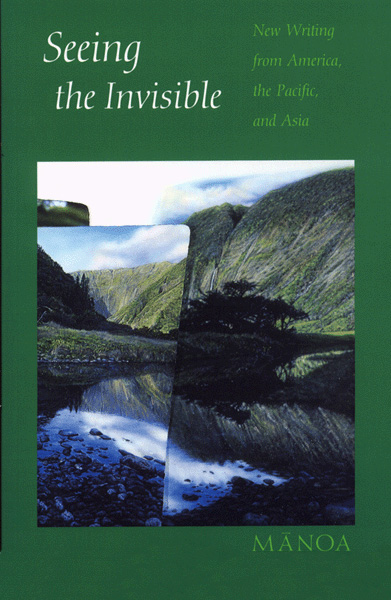
Seeing the Invisible:
Korean Women’s Fiction
256 pp., winter 1996 (8:2), $20
ISBN 978-0-8248-1906-4
JSTOR
Series Editor Frank Stewart.
Guest Editor Bruce Fulton.
Seeing the Invisible, MĀNOA’s winter issue, features a collection of new writing from Korea, with a special focus on fiction by women. Since 1987, the year of South Korea’s first open presidential elections, Korean literature has experienced a surge of vitality: novelists and short-fiction writers are publishing daring stories that enjoy a large readership at home and deserve an even larger one abroad. Korean women, it should be noted, are at the forefront of this new, popular fiction.
Among the contributors to this feature are O Chong-Hui, Ch’oe Yun, and Kim Hyong Kyong as well as the guest-editor Bruce Fulton, whose essay “Seeing the Invisible: Women’s Fiction in South Korea Today” discusses the growing prominence of women’s writing in South Korea.
Also in this issue are North American essays, fiction, poetry, and reviews. The authors include fiction writer David Borofka, the late Canadian poet and playwright bpNichol, and essayists Nancy Lord and Suzanne Paola.
The photographs and paintings featured here are by Hawai‘i artist Doug Young whose photorealistic watercolors are saturated with pigment and depict imagery from everyday life in the Hawaiian Islands.
About the guest editor: Bruce Fulton and his wife, Ju-Chan, are the translators of Words of Farewell: Stories by Korean Women Writers. With Marshall Pihl, Fulton translated Land of Exile: Contemporary Korean Fiction. In 1995 Fulton and his wife received a National Endowment for the Arts translation fellowship.
Extracts
“The events of that period twenty years ago have returned to my memory like a stage being lit. I see them first as a somber, bluish-green tableau. But then, as if through a window beside the tableau, a warm light emerges. It was a period of confusion. And above all else, suffering. Because it was left unfulfilled? On the other hand, are any of life’s stages ever brought to perfection? There are periods in our past that can’t be dismissed with a flippant ‘Oh, that time.’ They may be short periods, but they work their influence throughout our lives. Nevertheless, daily life is a powerful healer. Day after day snow and rain have fallen, flowers have withered and bloomed, and that period has gradually scabbed over, like a wound grown slowly insensible.”
—from “The Gray Snowman” by Ch’oe Yun