Secret Places:
New Writing from Nepal
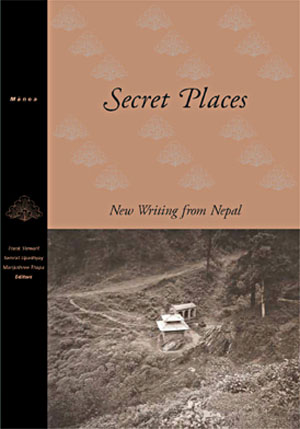
Series Editor Frank Stewart.
Guest Editors Samrat Upadhyay and Manjushree Thapa.
Guest-edited by Samrat Upadhyay and Manjushree Thapa, Secret Places features new prose and poetry from Nepal, a Hindu kingdom rich in cultural and topographic beauty but faced with especially difficult social, economic, and political challenges. Situated between the two most populous countries in the world and possessing formidable natural borders—the towering Himalayan range to the north and the tropical lowlands of the Tarai to the south—Nepal was geographically and politically isolated from much of the world until 1951, following a democratic revolution that toppled the hereditary dictatorship. The nation has since opened its borders to outsiders; even so, access remains difficult and Nepal continues to be sequestered.
Writers in Nepal have been courageous in addressing the country’s political and social concerns, including issues of individual freedom and the rights of minorities. And though the writing community is not large, Nepal’s authors work in a wide variety of styles and from various points of view concerning the role of literature in society. In her overview essay printed in this volume, Manjushree Thapa discusses Nepal’s contemporary writing community, and finds common ground among the more extreme stances. According to her, the mission of Nepal’s authors, regardless of their differences, has become twofold: to reach out to their own people—a society of dozens of languages, castes, and ethnic groups, with varying levels of education and literacy—and to reach out to the world.
About the guest editors: Samrat Upadhyay is the author of the short-story collection Arresting God in Kathmandu (Houghton Mifflin, 2001). His work has appeared in Best American Short Stories 1999, edited by Amy Tan, and Scribner’s Best of the Fiction Workshops 1999, edited by Sherman Alexie. His story “The Cooking Poet” was featured in Selected Shorts and read in Los Angeles by Star Trek actor Leonard Nimoy.
Manjushree Thapa is a writer living in Kathmandu. She is the author of a nonfiction narrative, Mustang Bhot in Fragments, and the translator of a collection of Ramesh Vikay’s stories, A Leaf in a Begging Bowl. She atttended the University of Washington’s creative writing program as a Fulbright fellow. Her first novel will be published by Penguin India this year.
Extracts
Like all Nepalis around the world, for the past few days I have been trying to put together a coherent understanding of the incoherent act that took the lives of most of my native country’s royal family.
One half of the Nepali heart has been reserved for awe and respect for a king-who-is-really-god, an incarnation of Lord Vishnu. The other half is stirred by images of political freedom. This tug-of-war between two halves of the heart exists even among the most-educated and most-intellectual of the Nepali people. “We need a king,” you’ll find doctors, teachers, cigarette-smoking writers say, even as they can’t, or won’t, tell you precisely why Nepal can’t do away with the crown and turn into a republic.
—from Samrat Upadhyay, “A Kingdom Orphaned”
Along the trail of the Muktinath pilgrimage
a simple old Nepali woman
examines me for quite a while and tells me
her son’s gone to work in Brunei
I can’t be translated into her son
figuring I’m here to sell hashish the old woman
puts on deferential airs and asks for a joint
then she spends a long time lamenting:
what else do we have to sell to tourists
except for hashish and our bodies
—from Shailendra Sakar, “The Naundanda Hills”
240 pp., winter 2001 (13:2), $20
ISBN 978-0-8248-2512-8
Project Muse
JSTOR
 MĀNOA
MĀNOA 