Russian Far East
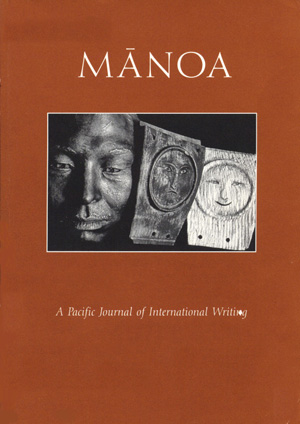
Editors Robert Shapard and Frank Stewart.
Guest Editor Adele Barker.
This issue’s feature, guest-edited by American scholar Adele Barker, includes folktales from native cultures on the brink of extinction; remembrances of the horrors of Stalin’s Gulag, which at one time virtually defined the Russian Far East; surprisingly tender fictions about displaced immigrants on the margins of empire; and new poetry by native and Russian writers. None of this work has ever been translated into English before.
The poets are Gennadii Lysenko, who died in 1978 but whose work is only now being discovered; Anna Khodzher, a poet of the Nanai people who writes in her native language and is perhaps the only published poet now doing so; Antonina Kymytval’, a poet of the Chukchi people who writes in Chukchi and Russian and is active in preserving her culture and language; Zoya Nenlyumkina, an Eskimo poet who writes in her native language and in Russian; and Alexander Petrovich Romanenko, whose father’s family is American, and mother’s family, Sioux Indian.
Among the fiction writers is Anatolii Kim, a well-known Sakhalin author of Korean ancestry. The non-fiction pieces include an introduction by guest-editor Barker to the writing of the Russian Far East; a chronicle by Pavel Markovich Nerler of the last days of Osip Mandelshtam, the great Russian poet who died in one of Stalin’s camps for political prisoners; a nature essay by Alaskan writer Nancy Lord on her 1989 visit to the Magadan region of the Russian Far East.
Other pieces include fiction by Vietnamese writer Andrew Lam and María Amparo Escandón; new translations of stories by Yasunari Kawabata; poetry by Cambodian writer U Sam Oeur, Kimiko Hahn, and Carolyn Leilani Lau; and essays on Alaska by Carolyn Kremers and Jennifer Brice.
About the guest-editor: Adele Barker lives with her son in Tuscon, Arizona, and has traveled extensively throughout Russia and the former Soviet Union. She is the author of The Mother Syndrome in the Russian Folk Imagination and coauthor of Dialogues / Dialogi: Literary and Cultural Exchanges between (ex)Soviet and American Women.
Extracts
“As I gingerly make my way inside, two carpenters are discussing how to finish a corner on a display case—a very nice one, I would add. The floors have been smoothed and sanded, inlays and fretwork finished, electrical sockets fitted into the wall. These are the moments that interest me, as the country embarks on the almost unimaginable task of restructuring itself. I look for change not in productivity levels or value of the ruble but in moments like these, which speak eloquently of the texture of that change: two carpenters discussing how to finish a corner, and a woman carefully collecting the artifacts of her people as a sign of the past and, perchance, of things to come.”
—from “Taiga Walks” by Adele Barker
“A gust of wind rose and tunneled through my blue shirt and set Maman’s hair flapping like a torn black flag. The wind carried with it the smell of the ocean—faint stench of dead fish, dry seaweed, salty air—and now, a little touch of Maman’s sweet jasmine perfume. It blew through the boat’s half-moon roof and reached Papa at the other end. The wind tilted the boat a little, and the poor boat creaked and whined its shy complaints. Behind Papa, the skinny boatman in his conical hat had to struggle very hard with his thin oar to keep us sailing smoothly eastward.”
—from “On the Perfume” Andrew Lam
“The women kept their heads down, looking modestly at the floor by their feet. They swayed gently with the drums and song, moving up and down and side to side. Their feet stayed flat on the floor, knees bending in time with the music, while their arms and heads floated like breezes. Their bodies mirrored the motions of the men kneeling before them, but the effect of their fans was different. The women’s soft tundra-grass and reindeer-hair fans brushed the air gently, while the men’s stiff wood-and-feather fans sliced like small knives.”
—from “We Are all Paddling a Kayak through
Open Tundra, Not a River” by Carolyn Kremer
“Once the Blackcrows had usurped the power
they started to evacuate people from Phnom Penh;
they threw patients through hospital windows
(women in labor and the lame), drove tanks
over them, then bulldozed them under.
The sun shone bright, as if it had come close to the earth.
The ground was dried and cracked.
Millions of panicked Phnompenhards jostled each other,
desperately overflowing along prescribed routes.”
—from “Exodus” by U Sam Oeur
“From the streets he could hear the buzzing of motorcycles and cars, first low, and then louder, and then low again, until it disappeared. (Yugoslav inflation, the deteriorating Hungarian economy, and stricter Czech visa policies had almost eliminated tourism from the two countries, and the once busy road was again as provincial as ever.) Voices of adolescents came from the streets, cheerfully and rudely carrying the notes of their hopes, talk of soccer, and girls. Then came the buzz of the quiet, and then the echoes of steps of a solitary passerby, and again the voices of the same adolescents, and then the same frogs, or if they were not the same, they sounded the same. The Japanese alarm clock emitted a hiss as minutes rolled over each other. Ivan looked at the flourescing green digits: 1:10. 1:11.”
—from “from Subterranean Fugue by Josip Novakovich
312 pp., fall 1994 (6:2), $20
ISSN 1045-7909
JSTOR
 MĀNOA
MĀNOA 