Post-Tiananmen Square
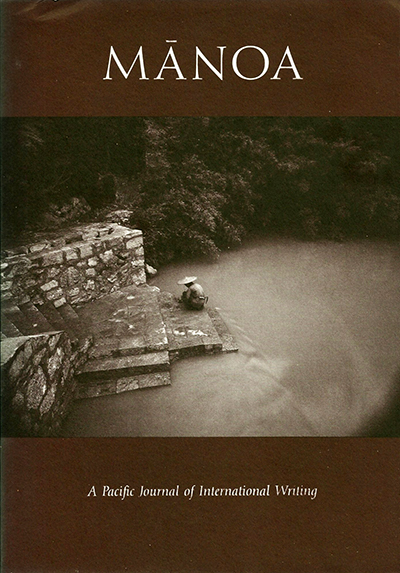
Editors Robert Shapard and Frank Stewart.
Guest Editor Arthur Sze.
The summer 1994 issue features post-Tiananmen Square poetry from the People’s Republic of China. Under the government suppression and harsh treatment of dissidents that followed the Tiananmen massacre, many writers fled the People’s Republic of China, landing in different places around the world and making the difficult transition to a life of exile. In this feature, guest-editor Arthur Sze gathers the poetry of eight major writers and interviews two of them about the political, cultural, and artistic difficulties they have encountered since their exile. The writers are Nei Ling, Xue Di, Bei Dao, Wang Jiaxin, Gu Cheng, Duo Duo, and Yang Lian.
This issue also includes nature and travel essays. Tony Whedon recounts his stay in the People’s Republic of China. Other travel essays in this issue take readers to the forest of Kahm in Tibet, the desert towns of India, and cities in the Northern Marianas Islands, Indonesia, and Japan. In his nature essay, Christopher Crossen discusses the interdependence between the natural and the human worlds in the context of Arches National Monument. Edward Hoagland writes about the ways nature writer John Muir celebrates the relationship that human beings may foster with nature through love.
Barry Lopez, best known for his nonfiction books, has a story parabolic in its brevity and mystery about a man who, prompted by the death of his son, struggles to recover personal, familial, and cultural history. Other fiction authors include Sharon Solwitz (“Fossilized”), James McCachren (“Bird-feeder”), John Zuern (“Ascension”), Karla J. Kuban (“Urchins”), and W.D. Wetherell (“Teaser”).
Also in this issue is an interview conducted in Hawai‘i by Steve Bradbury, Joel Cohn, and Rob Wilson with Japanese novelist, short-story writer, and Nobel Prize winner Kenzaburo Ōe. While still a college student, Ōe won Japan’s coveted Akutagawa literary prize, and now, some four decades later, he has been called the most formidable figure in the literary world of Japan.
About the guest editor: Arthur Sze is the author of River River (Lost Roads Publishers). His poems have appeared in Kenyon Review, Paris Review, and MĀNOA. His translations of Wen Yiduo will appear in Jerome Rothenberg’s Poems for the Millennium. Recently, he received fellowships from the National Endowment for the Arts and the Witter Bynner Foundation for Poetry.
Extracts
“On the snow-covered ground at the door,
a track of claw marks.
Do they belong to a deer, a roebuck,
or the legendary red fox?
I have no way of telling.
The fresh marks
clearer than the ancient inscriptions on marble,
so the poet awakes from a slumber
and begins to write.”
—from “A Visit” by Wang Jiaxin
“Absolutely, in China, everybody knows we don’t have a free situation…I really think every real artist is living a kind of exile, because their heart wants to do one thing but their land, their life situation, really cannot allow them to do it.”
—from “An Interview with Bei Ling and Xue Di” by Arthur Sze
“In China, since the famous (though anonymous) fifth-century B.C. poet threw himself into a river to protest his government’s corrupt policies, the poet has been expected to be a man of both public courage and private faith. This tradition flows through the courageous ‘public’ poetry of T’ang poet Tu Fu to the revolutionary poems of Mao Ze Dong, and culminates today in the work of exiled dissident poet Bei Dao. Implicit in the tradition are vows of poverty. Tu Fu is said to have remarked, ‘First you must become poor, then you will have a chance at great poetry.’”
—from “Courage and Silence” by Tony Whedon
“Central to our relationship to the Pacific are the Okinawans who have immigrated to Hawai‘i. This is something I am very eager to know about. There are many Japanese studies about Hawai‘i’s Okinawans. In 1981, for example, a major study was published called Okinawan uchinanchu, which is to say, Okinawans living in Hawai‘i. Also, many Okinawan scholars are now coming to Hawai‘i to collect materials on Hawai‘i’s Okinawans. One day I expect some very interesting studies to emerge from this. In Japan, historians always think of Japan as a very static culture whose structure is very vertical and so there is very little concern for horizontal heterogeneity. But I believe that now scholars are beginning to come out with studies of Japanese fishing and maritime culture that might begin to change the way Japanese history is perceived. We must come to see ourselves, Japan, historically as a very organic part of the Pacific. No one as written such a study yet, but I hope that gradually a history of Japan as a Pacific culture will be written. And in that history, Okinawa will hold a prominent place.”
—from “The Myth of My Own Village,” an interview with Kenzaburo Ōe by Steve Bradbury, Joel Cohn, and Rob Wilson
232 pp., spring 1994 (6:1), $20
ISSN 1045-7909
JSTOR
 MĀNOA
MĀNOA 