Pacific Islands
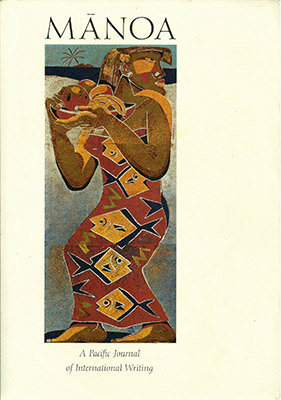
Editors Robert Shapard and Frank Stewart.
Guest Editor Vilsoni Hereniko.
The summer 1993 issue features work from the Pacific islands, guest-edited by Vilsoni Hereniko. There are interviews, poetry, essays, drama, and fiction by Samoan, Tongan, Fijian, Indo-Fijian, Rotuman, Banaban, and Maori authors in places ranging from Guam to New Zealand to the Cook Islands. Hereniko also interviews Samoan novelist Albert Wendt and the late playwright John A. Kneubuhl, who was part Samoan and who lived for many years in Hawai‘i.
The issue also includes “Stories in the Stepmother Tongue,” a special feaure edited by Josip Novakovich. It showcases the work of such writers as Jaime Manrique, Xiaoping Wang, and Samrat Upadhyay, who are American not by accident of birth, but by choice. None of their native languages is English; none of them began their education in schools where English was a dominant language. Theirs was a conscious choice to write in English.
Among the American contributors of fiction, poetry, and essays are James McCorkle, Martha Zweig, and Michael McPherson. The art portfolio consists of block prints and oil paintings of Pacific island subjects by Avi Kiriaty.
About the guest editor: Vilsoni Hereniko is the author of a collection of one-act plays and three full-length plays. Last Virgin in Paradise: A Serious Comedy is due for publication in 1993 by the South Pacific Creative Arts Society in Suva, Fiji.
Extracts
“For me, Pacific writing in English (and perhaps postcolonial writing in general) is best evaluated by the extent to which the writer has increased our understanding of ourselves or aspects of our universe as well as the chosen art form—whether it is a poem, short story, play, novel, or whatever. Our heightened awareness may come from one or all of the following and more: the cultural, ethnic, or political sensibilities portrayed in the work; the successful synthesis, or use, of oral and written traditions; the personal choice and treatment of subject or theme; the innovative use of the English language; the unique form or structure of the art; the use of original or unusual literary elements and techniques; even the challenge to literary hegemony. A poem that makes us reflect; a short story that illuminates dark corners of our experience; a novel or play that challenges the norm by offering an alternative that, in one’s opinion, is better, is a work that is worth the label ‘literature.’”
—from “Pacific Island Literature” by Vilsoni Hereniko
“After so many years I’ve found my people, Lu‘isa, and, through them, maybe myself. Yesterday the authorities called off the manhunt. All around, in the forests, women and young people went looking for us, to tell us. We could hear them shouting, ‘It is over! Tamasese has won! He lives again! Samoa lives!’ We came down from the mountains, out of the forests. Late yesterday afternoon I went to see Commissioner Allen. He didn’t know what had happened to me, probably didn’t care. He was smiling, even laughing a little, the way you do when the other guy has won the game and you’re a good sport about it. (To LILO) Do you know what he said to me? He said, ‘This infatuation with democracy will die down. Any movement that is supposed to be democratic is bound to get some sympathy at first. It is attractive, on the surface, but it doesn’t last. Thinking people realize soon enough that it is one of the greatest evils of the world.’”
—from “Think of a Garden” by John A. Kneubuhl
“Language may be ‘the house of being,’ but English seems more like a whole apartment complex. I wondered whether in the stories I’d read for this issue of Manoa—works by authors whose first language was not English but who now write in English—I’d see as many Englishes as there were writers, or whether the writers would mostly conform to the standard mode, as though living, indeed, in a prefab condominium. I think I found a refreshing variety of individual expressions.
“About two hundred people sent me about four hundred stories. I did not care what their previous publishing experience had been or whether the writers were established: I wanted good stories with intensity of language—of the adopted language. However, the English language, to my mind, is like a cat. You don’t adopt it, it adopts you; and you don’t control it as much as it controls you. So, since the adoption works perhaps more from the language than from us, I decided that the stepmother metaphor could well portray the new family.”
—from “Writing in the Stepmother Tongue: An Introduction” by Josip Novakovich
“It was 12 midnight. A bloody sun was crawling across the transparent sky. Numerous brown veils were flapping in the lanes fringed with high adobes. It was said that an old imam had just passed away and green grass was growing out of his snow-white whiskers. Inside the front hall of the mosque, a couple of men were sleeping soundly, clinging tightly to half-eaten nangs,some kind of Uygur pancake. The door was fastened with a rusty lock. And the sounds of the old man’s chanting of the Koran were still lingering, day and night, around the crescent tip of the mosque. The mourning procession was moving quietly down an ancient road, along which the exposed rocks were humming songs even older than the road.”
—from “The Midnight Sun” by Xiaoping Wang
296 pp., spring 1993 (5:1), $20
ISSN 1045-7909
JSTOR
 MĀNOA
MĀNOA 