Mexico
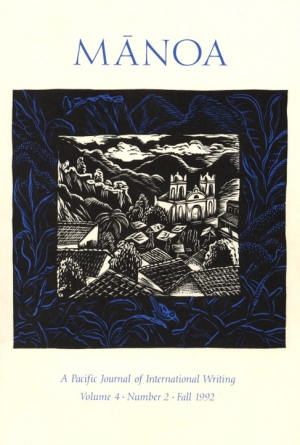
Editors Robert Shapard and Frank Stewart.
Guest Editors Hernán Lara Zavala and Darlaine Māhealani Dudoit.
This issue features fiction and poetry from Mexico guest-edited by Hernán Lara Zavala and Darlaine Māhealani Dudoit. Included in this feature are such writers as Luis Arturo Ramos, Silvia Molina, and Francisco Hernandez.
The subject of a symposium is the relationship between American fiction and poetry and nature writing as a literary genre. Titled “The Rise of Nature Writing: America’s Next Great Genre?” the symposium includes responses by sixteen nature writers such as Edward Hoagland, Barry Lopez, and Nancy Lord.
The American contributors of fiction, poetry, and essays in this issue are Alberto Rios, Diane Wakoski, Shirley Kaufman, and others.
The portfolio of woodblock prints is by Karen Wikström. Wikström was born in Sweden and has been living in California since 1977. She has participated in exhibitions at the San Francisco Art Institute, the Renwick Gallery of the National Museum of American Art, and the Los Angeles Craft and Folk Art Museum, among other places.
About the guest editors: Hernán Lara Zavala is a short story writer, novelist, and essayist born in Mexico City in 1946. He has published three books of short stories (De Zitilchen, El mismo cielo, Antologia personal), two books of essays (Las novelas en el Quijote, Contra el angel), and a novel (Charrasa).
Darlaine Māhealani MuiLan Dudoit is the managing editor of MĀNOA. Born and raised in Hawai’i, she is of Chinese-Hawaiian-English-Irish-Portuguese-French ancestry.
Extracts
“The abalone, the octopus, the toothless trumpet player who has been playing ‘The Man with the Golden Arm’ for three decades now, the crab, the deaf-mute who advertises being so on a sign hung around his neck, the snail, the blind man begging at the empty tables of La Roca,the oyster, the starving shoeshine boy and his twin dog, the huge shrimp . . . they blend their essences and their juices and save my life.”
—from “Means of Death” by Gonzalo Celorio
“It started as a recollection in Portuguese:
A woman’s voice, familiar
Over a collision of dishes. Night
After night, the blending smells of codfish;
Pinto beans followed by the old world
Habits of cigarettes
And pekoe tea sipped from saucers.
A gone time.
—from “From Saucers” by Sam Pereira
“I hope ‘natural history writing’ really signals a shift in direction for American literature, away from a concern with the pleasures, the pains, and the fates of the self toward a concern for the mysterious web of being in which we are all delicately suspended. And that people will someday say our years saw a renaissance in literature, not the resurgence of a genre; a rediscovery of the resilience, the pertinence, and the scope of natural history as a metaphor to illuminate the joy and the terror of human existence.”
—from the symposium “The Rise of Nature Writing: America’s Next Great Genre?” by Barry Lopez
240 pp., fall 1992 (4:2), $20
ISSN 1045-7909
JSTOR
 MĀNOA
MĀNOA 