Japan
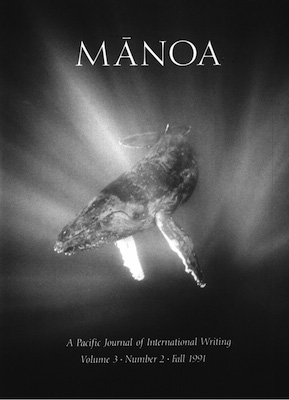
Editors Robert Shapard and Frank Stewart.
Guest Editor Masao Miyoshi.
This issue presents two special fiction features: modern fiction by Japanese women and recent fiction by American writers. Gathered in this volume is a collection of original translations of modern and contemporary stories by Japanese women guest-edited by Masao Miyoshi. Miyoshi’s essay in this issue, “Women’s Short Stories in Japan,” looks at the short story worldwide and at Japanese fiction in particular, with an eye to past and current differences in U.S. and Japanese literary cultures. Among the authors contributing to this collection are Ozaki Midori, Shiraishi Kazuko, Amino Kiku, Tsushima Yuko, and Hayashi Kyoko.
Fiction pieces by American writers guest-edited by Ian MacMillan are among the best that have come our way. Contributors include Gladys Swan, Michael Stevens, Chris Planas, and Walter Collett. As in every issue, we publish a selection of American poetry and this time we include poems by Denise Thomas, Richard Jones, Michael Hannon, and Phyllis Hoge Thompson.
This issue’s symposium, “The Situation of Reviewing,” is introduced by Alan Cheuse, who regularly reviews books for National Public Radio’s All Things Considered. In this symposium, Cheuse invited responses from people knowledgeable about book publishing, including authors, editors, book publishers, an agent and a bookseller—a number of whom are also reviewers themselves.
A new series of photographs of Hawai‘i by Wayne Levin are accompanied by an essay by Thomas Farber, “Sea-Change: A Note about Wayne Levin.”
About the guest editor: Masao Miyoshi is Hajimi Mori Professor of Japanese, English and Comparative Literature at the University of California, San Diego. His Off Center: Power and Culture Relations between Japan and the United States is being published by Harvard University Press.
Extracts
“The women writers relate to the empire and its people in a considerably different way from their male counterparts. However, as Japan’s new affluence softens the edges of its memories of poverty and suffering, its emergent bourgeoisie is embracing commodities with enthusiasm and passion. The erasure of the past deprivation is all that is needed for many people, men and women. The gender gap persists, but the frustration vanishes in the pleasures of acquisition and distraction. In fact, many women as well as men seem to believe that women’s acquiescence to men is an integral cause of Japan’s unprecedented prosperity. They ignore the presence of the marginal, the poor and the different. The state-corporate combine intensifies the campaign of homogeneity, and difference is made invisible.”
—from “Women’s Short Stories in Japan” by Masao Miyoshi
“The ivory of the white keys had aged to a honey color. Her grandmother was supposed to have played this piano seven hours a day, but she never became a concert performer; until her death, all she did was lumber through Chopin and lament that Kikue, the only one of the three sisters with any musical talent, had gone off to America and never come back. And even Kikue, after failing all her music-school entrance exams, never made her living from music, so in the end the piano was just a useless, alien presence, a kind of white elephant for the whole family.”
—from “White Wind” by Oba Minako
“One heard the sound—in my case,
muffled piano chords—which
set up a slight saw-edged vibration as though
beneath the skin,
a ripple or a wave, a curled edge lifting
black beyond the mingling
at the threshold’s littoral as it abandoned
human matter…”
—from “A Terror of Tonality” by Michael Heller
“Every time she picked up the paper it seemed as though hordes of people were moving somewhere else. Whole cities springing up from cardboard cartons and packing crates and old tires, with their little electric wires being run up to the main cable so that all these nameless multitudes could steal their little bit of light as they foraged for their scraps of food in the garbage dumps. Lives built on refuse. Here, Rob and Janet invited her to lift her eyes in order to imagine existence in its more gracious modes. Everything they’d done or planned to do poured out into a gleaming heap.”
—from “Veronica” by Gladys Swan
256 pp., fall 1991 (3:2), $20
ISSN 1045-7909
JSTOR
 MĀNOA
MĀNOA 