Japan
Editors Robert Shapard and Frank Stewart.
Guest Editor Leza Lowitz.
In her introduction to the feature in this issue, guest editor Leza Lowitz says she chose stories that, to use the words of Nobel Prize winner Kenzaburo Ōe, “express Japanese concerns in a literature of the periphery.” The writers included in the feature are Kiyoko Murata, Kyoko Hayashi, Yoshiko Shibaki, Hiromi Ito, Teru Miyamoto, and Ango Sakaguchi.
Kaho‘olawe, a small island in the Hawaiian chain, is the subject of two essays by Rowland Reeve and Pualani Kanaka‘ole Kanahele and a contemporary genealogical chant by Kanahele. In addition, there is an essay adapted from a brochure prepared by the Kaho‘olawe Island Reserve Commission for the ceremony marking the return of the island to the Hawaiian people.
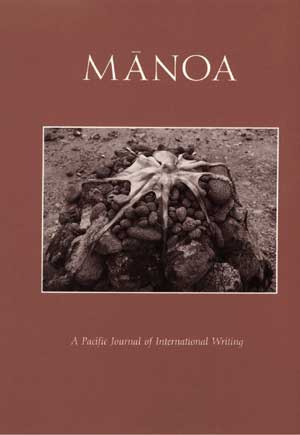
Accompanying the pieces on Kaho‘olawe is a portfolio of images of the island by Rowland Reeve and Hawai‘i photographers Wayne Levin, Franco Salmoiraghi, and David Ulrich.
The symposium for the summer 1995 issue was inspired by a panel of twenty-three poets, fiction writers, and essayists led by the poet Eric Pankey at the 1994 meeting of the Associated Writing Programs in Tempe, Arizona. His essay “To Repair the Material of Experience” is a response to a question posed by us: What place does religious and spiritual transcendence have in contemporary writing?
Marilyn Krysl’s essay recounts her harrowing experiences as a member of Peace Brigade International in Sri Lanka, a country that presents itself to the outside world as democratic but that routinely commits human rights violations. In his essay “The Rain Makes the Roof Sing,” Tom Montgomery-Fate reminds us, by considering what he learned while teaching in the Philippines, how limited American culture and language are in expressing human thought and emotion.
About the guest editor: Leza Lowitz writes fiction and poetry. She is the editor of A Long Rainy Season (Stone Bridge Press, 1994), an anthology of contemporary Japanese women’s tanka and haiku poetry, and other side river (forthcoming), a companion volume of free verse. She has taught writing at San Francisco State University and the University of Tokyo, and currently lives in northern California.
Extracts
“If you keep on being scared of falling, you’ll never ride the bicycle. Listen. We all learn by falling. Push against the ground more strongly with your foot and shift your weight to the pedal quickly. It doesn’t make sense to ask for a bicycle just because it looks nice to ride, but then not be able to ride it, does it? You can ask me to buy it, but your hands and feet have to ride it. You see? You cannot move something just by using your head and mouth. You have to use your body, too. Otherwise, nothing will move. Neither will the bicycle, OK? Remember that, OK?”
—from “The Midnight Bicycle” by Kiyoko Murata
“She stepped in to her waist. The skate did not move. When she waded deeper, it made a slight, almost imperceptible undulation forward—she smiled at its almost magical movement—and went under. The skate glided directly below her as she rode down over the seaweed and rocks barnacled and fringed with green. She came up for breath and went down again. It was there—as if waiting, white as she in the deeps. It moved, and she moved, she rose and it rose, her body thrust in long clean sweeps and it undulated, and as she turned, it rose over her and she saw its dark shadow under sun and then it went down, a white shadow in the dark below.”
—from “Lib” by H.E. Francis
312 pp., spring 1995 (7:1), $20
ISSN 1045-7909
JSTOR
 MĀNOA
MĀNOA 