Crossing Over:
Partition Literature from
India, Pakistan, and Bangladesh
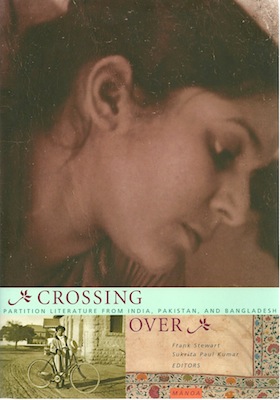
Series Editor Frank Stewart.
Guest Editor Sukrita Paul Kumar.
Crossing Over comprises stories from three South Asian countries—India, Pakistan, and Bangladesh—with a combined population of over two billion. The works here focus on the cataclysmic experiences of Partition in 1947 and its aftermath, including the Bangladesh War of Independence in 1971. Many of these works have not been readily accessible to American and other English-speaking readers; they serve as a mere glimpse at a rich and vast body of literature being produced in many languages of the Subcontinent.
Authors are Abul Bashar, Samaresh Basu, Rajinder Singh Bedi, Gulzar, Intizar Husain, Saadat Hasan Manto, Khadija Mastur, Joginder Paul, Mohan Rakesh, Bhisham Sahni, Kamleshwar, Rashid Haider, Prafulla Roy, and Urvashi Butalia.
Extracts
An aesthetic shaping of the incidents of Partition has been of deep concern to the authors in Crossing Over, especially those who lived through the events. Their subject was and continues to be the working of the human mind and heart at the collective, as well as the individual, level. The great task they have faced has been to describe and attempt to comprehend how normal human beings could so easily be swept into barbarism. Their approach does not derive from sociology, history, or political science. The best writers work in a more subtle realm, where the truth is revealed in a nonpartisan narration of life experience, and which does not put aside such essential human values as social justice, compassion, and love. At the same time, these writers do not flinch from the reality of combative feelings, criminality, vengefulness, and cruelty. Some have rendered events with stark realism; others have created parabolic stories; and still others have explored the psychic responses that give rise to nostalgia, the wish to recall and value a lost connectedness that transcends communal strife. Prafulla Roy’s Bengali story “Where There Is No Frontier” comes to mind in this context, along with Mohan Rakesh’s Hindi story “The Claim,” which ends with the driver of a horse-drawn carriage reminiscing about the mango tree he has had to leave behind—as well as his missing wife. He blesses his old horse with the words, “If God keeps you well, Afsar, the old days will return again.”
—from the Editor’s Note
Not much could be ascertained from newspapers alone, and since the guards on duty were illiterate for the most part, little information could be gained by talking to them. All they knew was that there was a man, Mohammed Ali Jinnah, who was known as Quaid-e-Azam, and that he had founded, for the Muslims, a separate country called Pakistan. Where was Pakistan? What were its boundaries? They did not know. For this very reason all the inmates who were altogether mad found themselves in a quandary; they could not figure out whether they were in Pakistan or India, and if they were in Pakistan, then how was it possible that only a short while ago they had been in India when they had not moved from the asylum at all?
—from “Toba Tek Singh” by Saadat Hasan Manto
240 pp., summer 2007 (19:1), $20
ISBN 978-0-8248-3227-8
Project Muse
JSTOR
 MĀNOA
MĀNOA 