Century of the Tiger:
One Hundred Years of
Korean Culture in America (1902–2002)

Series Editor Frank Stewart.
Guest Editors Jenny Ryun Foster and Heinz Insu Fenkl.
Century of the Tiger: One Hundred Years of Korean Culture in America commemorates the hundredth anniversary of Korean immigration to the United States. Included are some of the best and most eloquent Korean poets and prose writers in Korea and America; together with visual artists, they bring to life the dramatic, complex, and largely untold story of the Korean American experience. Editors are Jenny Ryun Foster, Frank Stewart, and Heinz Insu Fenkl, and designers are Hawai‘i’s nationally renowned graphic artists Elsa Carl and Clarence Lee.
Century of the Tiger is printed in a large format and has full color throughout. The book’s 260 pages include reproductions of Korean art pieces, many from the collection of the Honolulu Academy of Arts; reproductions of pieces by contemporary Korean American artists Karen Hong, Ezekiel Chihye Hwang, Kloe Sookhee Kang, Diane Chongmin Kim, Grace Kim, Jinja Kim, Colleen Kimura, Chang-Jin Lee, Sandra Sunnyo Lee, Mary Long, Naomi Long, and Kwang Kyu Yi; and stunning color images of Korea by Hawai‘i photographer Tom Haar.
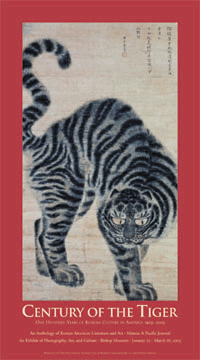
Poster based on the front cover.
Chapter Summaries:
Chapter one, “Land of Morning Calm,” summarizes the cultural history of Korea, including the country’s many innovations in science and technology and its artistic achievements. It also provides readers with the context in which Koreans began to leave their country for America. The chapter features excerpts from the novels of Younghill Kang, the first Korean American writer. Having participated in the March first demonstration of 1919 and been pursued by Japanese police through China and Russia, Kang immigrated to North America at age twenty-one. Awarded a graduate degree by Harvard University in 1927, he was celebrated in the U.S. for his writing and his strong advocacy on behalf of Koreans and Korean nationalism.
Chapter two, “Sailing to the Garden of Mugunghwa,” tells the story of the first wave of Korean immigrant workers, most of whom settled in Hawai‘i. The remainder continued on to the West Coast. Writers in this chapter include Mary Paik Lee and Morris Pang.
Chapter three, “Manse!” recalls the nationalist movement, in which Koreans at home and abroad attempted to free their country from Japanese occupation. The movement not only created strong bonds among Korean immigrants, but also tragic splits as groups disagreed over the best strategies. Authors in this chapter include Margaret K. Pai and Richard Kim, as well as Korean poets Kim Sowol, Yi Sang-hwa, Sim Hun, and Yun Dongju.
Chapter four, “War and Liberation,” brings to life the turbulent years from 1941 to 1953. Many Koreans were hopeful that Japan’s defeat would lead to freedom for the homeland. In 1950, however, a bitter civil war erupted in Korea; after a three-year conflict, the country was devastated and thousands of families were divided. The writers in this chapter include novelist Kim Ronyoung, a daughter of the second generation who was born in Los Angeles. Like many of the parents of Kim’s generation, her mother was an activist in the Korean independence movement and devoted time and money to nationalist causes. Other writers in this chapter include Gary Pak, K. Connie Kang, Chris McKinney, Hwang Sun-won, Walter K. Lew, So Chongju, and Chon Sangpyong.
Chapter five, “New Arrivals in a Changed America,” brings readers to the present. In the second half of the twentieth century, Korean immigrants came to the U.S. in greater numbers and acquired new rights of U.S. citizenship, increasing the Korean American population to over one million. The chapter includes contemporary fiction writers Chang-Rae Lee, Caroline Jeong-Mee Kim, June Unjoo Yang, Ha-yun Jung, and Don Lee. Featured poets include Sue Kwock Kim, Ishle Yi Park, Naomi Long, Ok-Koo Kang Grosjean, and Kim Yangshik.
256 pp., winter 2002 (14:2)
paper, $24; cloth, $45
ISBN 978-0-8248-2644-2
Project Muse
JSTOR
 MĀNOA
MĀNOA 