Beyond Words:
Asian Writers on Their Work
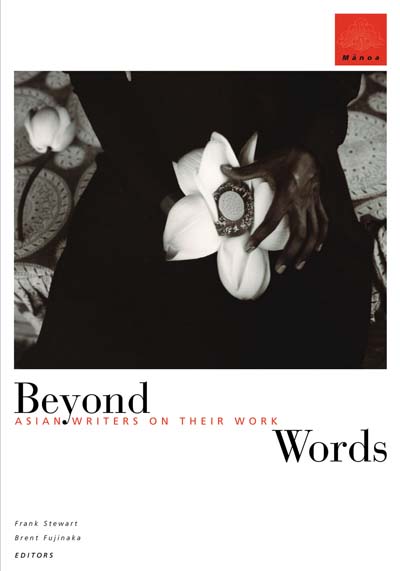
184 pp., summer 2006 (18:1), $20
ISBN 978-0-8248-3058-8
Project Muse
JSTOR
Series Editor Frank Stewart.
Guest Editor Brent Fujinaka.
Beyond Words presents more than two dozen authors from China, Tibet, Japan, Korea, the Philippines, Indonesia, Viet Nam, Cambodia, and Malaysia. The issue features a full range of perspectives on writing shaped by nationality, language, age, gender, and aesthetics through essays, interviews, stories, and poems.
Some of the contributors write to effect social justice, political reform, or freedom from an oppressive government. Others are more concerned with the inner movements of the heart, to family, or to their spiritual nature. Some adopt experimental forms and the mixing of genres, while others look to traditional spoken or literary forms. Still others write of the hazards and surprises of creating in other languages, or writing in countries with many languages and dialects.
Despite their diverse viewpoints, every author in Beyond Words is committed to the power of literature to transform readers, society, and themselves. The effort to write well, to be understood, to innovate, to celebrate, to comfort, and to protest—all are contained in this rich and engrossing collection of voices from Asia.
Extract
The poet is, in a certain way, like a masked dancer with poetry as his mask. The writer is hidden by his mask, and when he is “on stage,” we cannot be sure that in his exciting and memorable expression he is describing the character of the mask or the face of his own soul. In the end we must come to the realization that we are faced not with an individual self, and not with a final conclusion or something finished, but with a dance: a form and a statement in process. There is always something in the dance that is not, or never will be, final—a question that will arise time and again. That is the pasemon, the allusion that rejects the certainty of knowledge.
—from “Pasemon: On Allusion and Illusions” by
Goenawan Mohamad, translated by John H. McGlynn