Australia
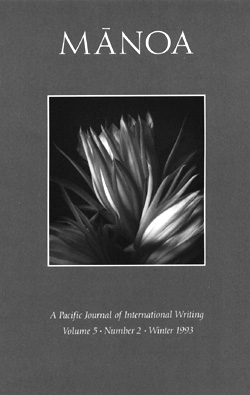
Editors Robert Shapard and Frank Stewart.
Guest Editor Christina Thompson.
The winter 1993 issue, guest-edited by Christina A. Thompson, includes fiction, poetry, and memoirs from Australia. The pieces here represent a large cross-section of Australian voices, combining the works of authors from many different walks of life in an unusual way.
Included are memoirs of Aboriginal life, historical fiction, Greek-Australian poems, an outback detective story, an excerpt from a novel in verse, a memoir set in New York, and a reflection on a long literary life by one of Australia’s best-known writers.
The American poetry ranges in setting from the hot plains of Texas to the snowy terrain of northern Michigan and in subject matter from the horrors of war in the Balkans to a parent’s tender concern for his child in the night; from the flight of seaside dunlins to a lover’s scars.
In this issue’s nonfiction work, the fragile and fantastic worlds found in the waters off Alaska and California are rendered by American writers John Hildebrand and David Rains Wallace.
About the guest editor: Christina A. Thompson is an American who has lived in Australia since 1984. She is a postdoctoral research fellow in the English department at the University of Queensland, and is working on a book about the Pacific called “Come on Shore and We Will Kill and Eat You All.”
The photographs of Hawai‘i artist Franco Salmoiraghi are the featured artwork. Salmoiraghi, a resident of the islands since 1968, has his black-and-white photographic prints in the collections of many public and private institutions.
Extracts
“Australian history replicates that of America in some significant ways. Both were originally established as colonies. In both cases, this establishment entailed the displacement and subjugation of an indigenous people by a predominantly Anglo-Celtic population. Both grew as a result of migration from the fraught places of the world. Both promised, even if they could not guarantee, economic and political freedoms. And both are now struggling to adapt to the realities of their polyphonic, multicultural, postcolonial populations.”
—from “A Brief History of Australia” by Christina A. Thompson
“My history, like the history of my country, is nothing but great moments. Here is another: it is the moment of my first lie. It does not look like much, this great moment. I stood between two roses of the carpet in my parents’ house, still small enough to see only the knees of the adults in front of me, small enough to hear my teeth clatter against each other when those adults, my parents, bent down one by one and shook me. It was Alma,I told those knees, Alma did it. Alma behind me, too small to be able to find words for outrage, bawled and bawled, and the precious luster jug continued to lie in glittering fragments between us. My lie became more elaborate, as I took my first steps into the foreign country of untruth. Her hands are too small, she dropped it, I said, and felt dizzy, knowing I was adding a new world of my own invention to the one I had been living in until now. She wanted to look at her face in it, I said, which was even more cunning for being true, although it was not the reason for the jug now lying dead. And she could not hold it in her hands, I continued plausibly. Alma, who did not know yet about the new world of lies, but would soon learn, became hoarse, bellowing and wailing as they spanked her pinafore and stood over her, scolding, and I crept away with a new world in my head.”
—from “Great Moments in History” by Kate Grenville
“There was a certain irony in speaking of sea otters as trashing anything in the wake of the Exxon Valdez,when images of dead sea otters mired in oily goo, jaws caught in fatal rictus, ‘trashed’ so to speak, had become the quasi-official measure of the spill’s damage. . . . three months later, on the outer coast of Baranof Island, the spill seemed only a distant rumor of war. . . . But the spill had forced many sea otters to migrate to new territories, presenting an opportunity to examine the effects of otter predation on previously undisturbed areas. We would be looking chiefly at their prey, marine invertebrates, creatures so small and arcane as to call into question where their lives even fit into the big picture.”
—from “Beyond Whales” by John Hildebrand
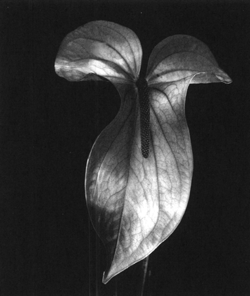
Obake Anthurium
Photograph by Franco Salmoiraghi
248 pp., fall 1993 (5:2), $20
ISSN 1045-7909
JSTOR
 MĀNOA
MĀNOA 