A Review by Kai Julian
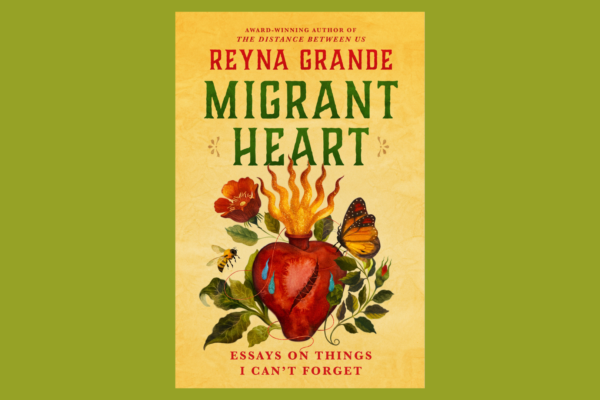
Migrant Heart (2026) by Reyna Grande is an intimate and poignant memoir that explores the interconnected themes of immigration, family separation, acculturation, identity fragmentation, intergenerational trauma, and child abuse among many others. As an undocumented nine-year-old Mexican immigrant who turned into an award-winning author, writing teacher, motivational speaker, and immigrant rights advocate, Grande draws deeply from her lived experiences and shares her authentic reflections to uplift others who have endured similar struggles as well as raise awareness to the challenges and complexities of immigration.
Migrant Heart consists of a mosaic of introspective essays that relate stories from Grande’s childhood to adulthood in a non-chronological timeline. Produced as a response to her previous memoirs, The Distance Between Us (2013) and A Dream Called Home (2019), which focus more on the harrowing events and emotional traumas of her immigrant experience, Migrant Heart takes a more constructive and lighthearted perspective, concentrating more on the positive aspects of her circumstances without diminishing their significance. It is a memoir that pushes the author to confront and reframe her inner turmoils and rise above them, allowing herself to center her life in the present and fully look forward instead of dwelling in the past. At the same time, the book enlightens readers to see beyond the socio-political narrative of immigration and propels them to re-examine its existing landscape.
The memoir starts off with a story about the author’s wedding and how she originally remembered it as a day full of mishaps. She then recounts a past interaction with one of her friends and how this friend called her “the queen of misery” after reading her first memoir, The Distance Between Us (Grande 2026, 2). Accompanied by her editor’s advice to omit the depressing chapter about her wedding in her second memoir, A Dream Called Home, Grande finally came to realize how she used to always find ways to twist her memories, happy or sad, into something tragic. This was the result of her years of choosing to play as the victim of her experiences, developing a “fixation on trauma” (Grande 2026, 9). This fixation functions as a defense mechanism when one attempts to become hypervigilant toward any future threats that might hurt them again. Recognizing the toll on her mental and emotional health, as well as her desire to escape reliving her traumas whenever she writes about her misery, Grande pivots the narrative about her wedding in Migrant Heart by recapitulating it through a more optimistic lens. In this first essay, Grande establishes a shift from wound tracing to active healing that sets the tone for the rest of the book.
The collection captures the author’s internal conflicts in visceral ways, especially in the essays that speak about her mother. In “Juana La Mexicana,” Grande portrays her mother as someone who refuses to assimilate to American culture, further distancing their mother-daughter relationship as the author grows up more and more American. Grande shares the frustration and shame she feels about her mother’s behavior while demonstrating the guilt, grief, and alienation she also suffers from as she outgrows her. She illustrates the stark gap between how the young and the adult immigrants integrate into Western society. She explains how her parents’ “certainty in being Spanish-speaking Mexicans inoculated them against assimilation” while she, as a child immigrant whose identity was still undergoing formation, was torn between “two languages, two cultures, two loyalties” (Grande 2026, 33). As a child immigrant eager to attain belongingness from her peers and the rest of Western society, Grande shows how much more pressure she faced and willingness she held to assimilate. However, the more she assimilated into Western society, the more she became disconnected from her Mexican roots and family. Despite struggling to fully connect with her parents, especially her mother, Grande exemplifies through her daughter’s Spanish language education how a bridge is built between Grande and her mother, fostering reconciliation between generations.
The book’s multi-essay form enables Grande to fluidly move between her reflections and memories in a way that delivers her narrative with more evidence and impact to readers. Instead of connecting one chapter to the next, each one is a stand-alone essay. This structure allows the reader to start at any essay and pause anywhere without feeling lost. The overarching themes of immigration and family separation bind all the essays together. They ground the reader by providing consistent points of reference, solidifying the reader’s understanding of the author’s experiences as well as empathizing with them. They also stabilize the pacing of the entire book. The narrative is deliberate in a way that entitles the reader to pause, absorb, and ponder about the book’s deeper meaning and bigger purpose. Grande also utilizes the hermit crab form of a script, dictionary, almanac, and a couple others in some of her essays. This technique demonstrates Grande’s literary ingenuity, but most importantly her ability to still find solace in her craft despite the painful nature of its content. A sense of control is also remarkable in Grande’s prose. She employs a textural balance between evocative and grounded prose in the way she expresses her interiority and relates events, reflecting her conscious effort to extract herself from her pain to make room for joy. Grande’s overall writing approach to her book, Migrant Heart, evidently echoes her intentions for a more objective and redemptive work compared to her earlier ones.
Migrant Heart is a transformative memoir about the scars carved by migration, and the long and arduous journey toward healing and self-redemption. It broadens representation of the immigrant experience. It challenges the flattened rhetoric of immigration portrayed in politics, news, and media. Ultimately, it invites dialogue across different cultural communities, providing deeper understanding and nurturing empathy among people who live in the United States and across a fractured world.

Kai Julian is an undergraduate student at UH Mānoa majoring in English. She already earned her Master’s in Financial Accounting from Rutgers University and worked in accounting, finance, and data management. She also undertook freelance writing projects. She decided to return to school to refine her writing skills in hopes of becoming a published author. Her diverse academic and professional background guides her writing. She leverages both of her analytical and creative skills for her craft. Julian’s creative works are mainly focused on fiction and she is particularly interested in the ways fiction bridges the everyday mundane and the whimsical world.

Leave a Reply