Review by Krysten Nakamura
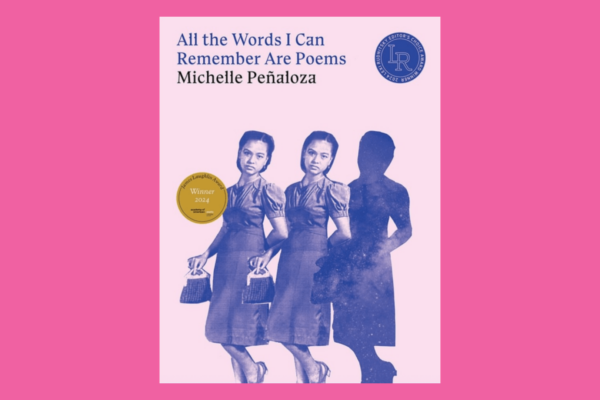
Michelle Peñaloza’s All the Words I Can Remember Are Poems asks readers to slow down. I read Peñaloza’s poetry collection on a quiet Saturday, in between scoops of last night’s rice and laughter with my sister over a cheesy horror movie. In this collection, Peñaloza, a child of Filipino immigrants, shares reflections over eating the last of the beef jerky, her dead father calling her through fingers of okra, and her grandmother’s purse. In other words, Peñaloza writes the everyday: what it means for a daughter to face her family’s past, her cultural past, and a past she has not yet met.
The collection is divided into three sections: the first, a look inward to her mother’s inherited fear of snakes, a three year old’s game of hide-and-seek, and the ties of her zodiac animal to her cousin’s pig pen. The second, a look outward at the image archives of the Philippine–American War, the speaking remains of an unearthed mass grave, and living in California with the ghosts of colonialism. The third, a look forward toward her unborn child’s wholly existence, laughter from a writing group’s text messages, and a joke t-shirt her tita proposes buying for her white husband. Peñaloza uses space to offer us breath and breadth: On the page, her poems stretch syllables diagonally, extending our voices down, down, down into childhood memory. Text set along the right margin propels us toward the future, oriented by the physical lines extending and returning to the left—the past. A series of diptychs embody voices of the archives, speaking to one another up and down, left and right. The use of contrapuntal form reminds us that the past echoes from many voices and to listen in all directions. Peñaloza also includes a series of full-color collages interspersed throughout the collection. Her own artwork allows us space to pause, slow down, and consider her words from new patchworks.
While Peñaloza delves into a variety of topics, at the collection’s core is a meditation on community. Peñaloza’s ancestral community weaves in and out of the collection, like the image of a clementine sewn into Lola’s silhouette. A poem of gratitude dedicated to her Tito Rofel, lovingly remembered as the first poet in her family, asks us to reflect on our lineage, both familial and writerly. Community between writer and reader, too, is found across the page: Peñaloza sparks reflections of my own when she tussles with her mother, asking, “what can I offer my mother when we cannot agree on the truth?” (Peñaloza 2025, 4). In writing her mother, Peñaloza offers her pen to me, sprouting from indented margins. Peñaloza’s Filipino community is buried deep within inherited memories of mass graves, the threat of snakes, both animal and human, and uprooted with the harvesting of a vegetable her father planted. Peñaloza reaches through the page, asking, “Reader, what is it I need you to know? / You, too, are a consequence of conquest. / We’ve been American for a very long time” (Peñaloza 2025, 44). Here, community is fostered among the violence of American colonialism in the Philippines and the lasting consequence of these conquests today, among readers today. In the wake of colonial violence, unearthed memories of ancestral trauma, and unsettled relations of the self to the homeland, what do we do?
For Peñaloza, the answer is to be a poet. Within the collection, there is a poem about the promise of writing a poem, a poem prompted by the declaration of, “imma write a poem with that title,” a poem of love from one poet to another, and a poem on the process of writing a poem (Peñaloza 2025, 57). Poetry allows for Peñaloza to explore violent and contentious colonial history through collage and ekphrasis. She channels voices from beyond the grave, projecting the spectral truths of a school girl, of diaspora, of taxonomized insurgents. Poetry allows Peñaloza to converse with her grandmother and unborn child, to meet them on the page, a medium through which she can make contact beyond the physical bounds of the human. Poetry allows for Peñaloza to “get” the reader, the fellow poet, and together, create a community of reflection and consideration for the writer’s past and future. But what allows Peñaloza to reach these explorations, conversations, and community is not poetry itself, but being a poet.
A poet’s life—one where you seek the poem in beef jerky, use the word “love” because you love your family, find joy in analyzing the use of the word “get” instead of “have” in a dollar store’s name—is the life Peñaloza lives. Peñaloza writes, “When the world is trash, there’s trash pizza” (Peñaloza 2025, 58). When the world is trash, there is the poet, taking what is left and turning it over, into the steam rising from her grandmother’s rice cooker. When the world is trash, there’s laughter with your sister, and a lazy Saturday where all you have to do, all you want to do, is read poems and write about them. What else could be more like a poem? (Peñaloza 2025, 63). As Peñaloza writes, “I will not explain. / Some deals only we get. / Only for us” (Peñaloza 2025, 59). In a world that is actively burning itself to the ground, a poet’s life is what saves us all.
Krysten Nakamura is an MA student at the University of Hawaiʻi at Mānoa in Literary Studies of English. She aims to write about her Hawaiʻi-born Japanese identity at the crossroads of scholarship and creative nonfiction. When Krysten is not writing, she is baking banana bread, collecting strawberry accessories, and taking photos of the moon.

Leave a Reply