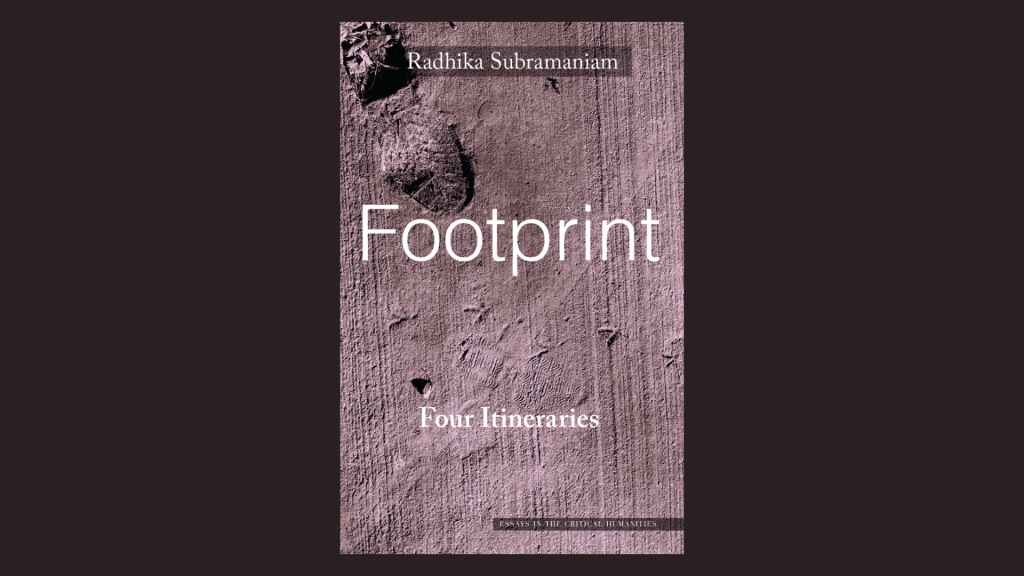
Review by Alia Jeraj
Consider what it takes to make a footprint: First, the weight of a foot must press into a permeable surface. Then, it must leave. Now consider what it takes to preserve that print: a perfect set of geologic and meteorological conditions, or perhaps intention, by the printmaker or an invested witness. Finally, consider what further impressions might be made upon the discovery of that initial impression, that footprint.
In a new essay collection, Radhika Subramaniam explores the complexities of a Footprint, from who makes them and how and why, to their preservation, to the meanings people make of them. She names these essays itineraries, taking readers on a journey that follows literal and metaphorical footprints on and orbiting our planet and across hominin history. Along the way, she reveals some of the various impressions, absences, presences, metaphors, and movements inherent in a footprint.
This journey, much like a footprint, is not straightforward. An experienced navigator, Subramaniam gives her readers a “Guidepost,” indicating that the book’s path is winding, and inviting us to explore the itineraries in the order they appear—or not. She lets us know that “the itineraries are not about the footprints found therein; rather, they travel with footprints to bring into view the intersections, collision, and contradictions of this very material metaphor.” The importance is not in the footprints themselves, but in the meanings we make of them. And like anything worth exploring, the potential meanings are plentiful.
Another important part of preparing us for the journey is calling attention to the breadth of footprints. In her guidepost, Subramaniam asks us to consider: footprints painted onto maps by indigenous cartographers for Spanish colonialists; footprints on the surface of the moon; and the carbon footprint. Embedded in each of these footprints is something different. They show migration and belonging, they mark conquest, they (purport to) measure complicity. Subramaniam masterfully uses these varied footprints to examine human politics and social justice, finding connection and contradiction.
Subramaniam’s first itinerary, “Stride,” begins with the footprints humans left on the moon, perhaps one of the most obvious evidences of human technological prowess. She connects these footprints back to ones left by our earliest hominin ancestors, emphasizing the experience of movement through our species’—and our species’ ancestors’—history.
Even when talking about the very material footprints found on the moon and across the globe, one cannot escape the metaphors inherent in a footprint. Subramaniam calls attention to them, the idea of “following in someone’s footsteps,” a common phrase that’s perhaps not given the thoughtfulness it deserves. One could look at our early hominin ancestors and the way they moved across the globe. We could point to that movement and say that our journeys into our planet’s outer orbit is “following in their footsteps,” though, of course, their footsteps were never on the moon. These contradictions make the exploration of a footprint so interesting. And perhaps even more compellingly, Subramaniam doesn’t give us answers—she invites us to work through them without reconciliation.
Part of the inability to reconcile is the inherent movement, absence, and relationality found in footprints. Footprints are made by physical beings, but they only become apparent in that being’s absence. They are voids, spaces to be filled with meaning, made by movement. Subramaniam writes that a footprint “is not entirely stable in the present nor in the past but can be continually encountered anew.” They cede ground to whoever—or whatever—follows. She asks us to not only consider, but reconsider what a footprint might mean. How might we understand footprints beyond impact and occupation? And how might this new understanding shape our relationships to movement and belonging.
In addition to footprints made by human/bipedal feet, Subramaniam also introduces us to footprints painted, and non-human footprints—metaphorical and architectural. These add nuance and expand our understanding of what a footprint is and can be. In the spirit of a footprint, she cedes this exploration to us, inviting us to continue our journeys. Since going on her journey, I haven’t been able to stop thinking about a footprint she didn’t mention: the digital footprint. How might we carry the metaphor of physicality, movement, and absence into the digital sphere? What can the humble footprint teach us about the connections we make in non-physical spaces?
I don’t think it’s an understatement to say that going on Subramaniam’s journey changed the way I think about language. Even writing this review, I’m forced to reconsider each metaphor of journeying, walking away from, and footsteps that comes up. Her Footprint does all the work a footprint should, creating a space for us to continue to make meaning and relationships as we continue the journey.

Alia Jeraj (she & they) graduated with her MA from the University of Hawaiʻi at Mānoa in 2024, where she researched a Shi’a sung-poetry tradition in northern India. Before starting their MA, Alia lived in the Twin Cities, MN, where their work was published in venues including: American Craft, Pollen Midwest, Twin Cities Daily Planet, and the Mill City Farmer’s Market blog. Alia currently works in the mountains, restoring burnt native forest. When she’s not collecting seeds or planting trees, you can find Alia curled up with a cup of coffee or crafting.
 MĀNOA
MĀNOA 
Leave a comment