
Review by Carson Compos
There are beautiful bodies buried within Find Me as the Creature I Am. Poet, translator, editor, and professor of Korean literature Emily Jungmin Yoon’s second collection of poetry uncovers connections between death and love and offers dualities of violence and peace to come to the conclusion that, in many ways, we are animals.
I came to this collection in a dire state—the fires sweeping California, the results of the election, an ongoing genocide that shows no sign of stopping… I couldn’t help but feel dread. These poems pulled me to find the beauty that exists in the world, even when feelings seem unbearable. Yoon’s poems reflect on many sources of grief—for her family, from the destruction of the climate, from racial violence—but grows from them to become personal meditations on the nature of her own being, finding love in places that are unexpected. One of my favorites from the collection is her poem “The Blades”, which opens:
You cut down on the gopher in a single, crisp stroke
in the garden. In it also your mother’s prized orange tree.
A blue jay your family feeds and has trained.
There is an act of mercy in this moment of killing—the line break separating the gopher’s death from the garden. The gopher was seen as a threat to the family itself—a justification for its killing. Could there be a world where the gopher can live in the garden with the blue jay and the orange tree? We know this is impossible if the garden is to be protected. As the poem develops, the scene widens:
To keep us in check, a Texas man took it upon himself
and stabbed an Asian father and two sons,
cutting their faces open. One of the children has a gash
pointing to his eye, the damage itself in the shape
of a blade. A delta. Wanting to breach another opening.
The connection of the speaker’s past to a hate crime that occurred in 2020 pulls me deeper into the earlier themes of violence. My first reaction, however, is to recoil; how can these two scenarios be at all similar? I yearn for the garden in my realization of how cruelty scales when we enter the world. In the perspective of a killer, are they gardener, and others gophers, animal?
… Every day someone leans the shovel
and knife, real and not, against a gentler thing
In a world that feels full of hatred, what separates murder and mercy is love. Within that gap gives breath—haunting peace that follows a moment of brutality. Yoon finds that we are all capable of great violence, the only difference is our reasons for picking up the shovel, and why we release it. She has an ability to reflect on something horrific, like a hate crime—like murder—and offers the reader something beautiful, something other than pervasive dread.
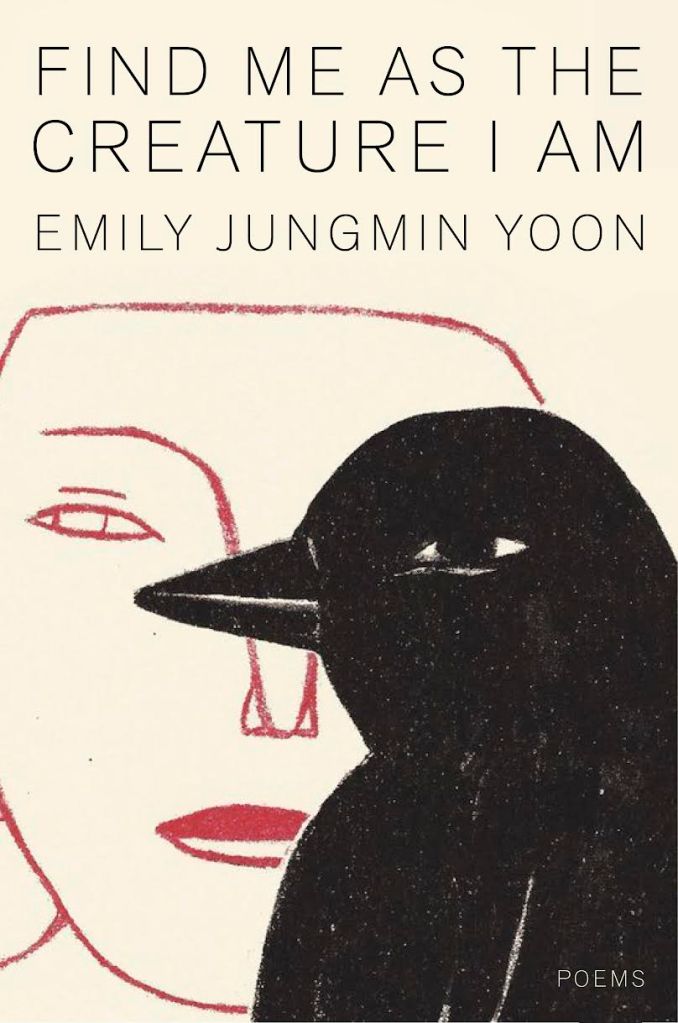
This collection is full of meditations on sweeping subjects: the duality of definitions, such as “Affection means both fondness and disease” in relation to appreciating the color of the rose-ringed parakeet, an invasive species to Hawai’i; or the objectification of “the body of a woman, for which body means collective”. These poems often begin in the same sensation in which I entered them, overwhelmed by a world we wish would change. While Yoon validates and acknowledges her own doubt, the collection is a place in which the speaker discovers something about themselves, finding that “…I love / my father’s eyebrows on my face. I love my mother’s calves and I love / the parts of myself that I do not name. Let that be enough.”
Through all of this, Find Me as the Creature I Am is a celebration—for the existence of life and love in the confrontation of our futility, declaring in her last poem “Next Lives”: “I love you and I dread the future. / I dread the future and I can’t wait / to keep living with you…”. Like time and space, these forces of dread and love are inseparable—life is worth living because there is more than just despair, even when we don’t know it’s there.
Carson Compos is a Chicano poetic alchemist—our earliest translations place his birth somewhere in the 16th century. Last I heard, after drinking from the fountain of youth, he locked himself in his tower, where he continues to question the collective consciousness of humanity through his concoctions of composition. Some fear with each verse he gets closer to turning gold into words.
He’s also a first year MA student for Creative Writing at University of Hawai’i.
 MĀNOA
MĀNOA 
Leave a comment