
by Chandanie Somwaru
I met with Shilpi Suneja on a sunny O’ahu day, where we shared in our love for food, the rhythms of Chutney music, and shared giggles over things our mothers do. Encountering Suneja’s poetic storytelling carried me into a world where it made me wonder about home, about the language we speak and the languages we lost.
House of Caravans is a novel bound tightly in the act of remembering all the people that were affected and are still being affected by the Partition in 1947 that separated what was home into two nations: India and Pakistan. This haunting and breathtaking narrative holds onto the reader and asks how can we forget our past when it still lives in our present?
As a South Asian woman writer, Suneja’s novel gives us the reason why stories, people, and land are interconnected and should never be overlooked. I am so delighted for readers to experience the art of her craft.
Chandanie Somwaru: As I was reading, I thought about the idea of duality, the duality of identity, of culture, of religion, of countries as well as the complexities and contention of this duality. Could you talk a little bit about how you decided to play with this idea, especially in the time and setting that you’re working with?
Shilpi Suneja: You know, we think in terms of binaries and I don’t know how productive that is. It’s something that I’m trying to not do, but you know, it’s the idea of father-mother, good-bad, good versus evil. Especially, growing up, the way that the nation of India has taken up the narrative of Hindustan and a nation for Hindus, it seems it is actually targeted towards not simply minorities but Muslims in particular. So the idea of creating that narrative of “these people are invaders and we are the indigenous” even though the actual indigenous are the Adivasis who are now fighting for identity and land, I was very aware of this idea of Hindu versus Muslim in the 90s when I was just a small child.
A very decisive thing happened when this Hindu mob destroyed the Babri Masjid in 1992. This year they’ve completed this Hindu temple on that very spot and people are celebrating this. For those of us who remember what stood before in that place, it’s a huge moment of sadness and shame. This is not something we should be proud of. It’s something that should make us remember this very odd construction of this identity of Hindustan for Hindus. Yeah, so again, when you grow up seeing those riots, you’re supposed to say Hindus and Muslims are rioting, but really it’s a pogrom against the Muslims. And this has happened time and time again and it actually links back to Partition when the political leaders of South Asia contended with this idea of a separate nation along religious lines. As South Asians, religion is a huge part of our identity and it kind of translates into national identity, which it really shouldn’t. Religion should not decide borders.
Having read a lot of the political dialogues of the time, like what Jinnah wanted, what Gandhi wanted, what Nehru wanted and what the leaders of the other smaller oppositional parties wanted, with them thinking in this term of duality of the majority, they believed “Hindus will take over and there won’t be any space for Muslims. Therefore, we need this Muslim nation,” which made a lot of political sense and yet it led to that awful bloodshed where one million people died. We talk about the Holocaust a lot and now we’re witnessing the same kind of genocide in Gaza. Again, a two-nation solution is never a good solution. So I’ve always been thinking in terms of the duality of two nations, two separate religious identities, two communities living side by side.
Somwaru: I noticed in the back of the novel, there is a bibliography and it has some really good sources and you also mentioned just now how you were reading and thinking about the time of Partition. How much influence did these sources and research have on your writing? How did you embody that theory in your work?
Suneja: For so long all I did was read, and people have asked me “you know a lot of immigrant writers, their first book is about their own experience, so why are you writing about Partition? Why are you writing about your grandparents?” To me, it just made sense to pay homage to my grandparents and then sort of move on to talking about myself. I’m only just coming around to the idea that it is okay for me to tell a story about myself. But I thought that steeping myself in scholarship and in learning about postcoloniality would be a better, more enriching route for me as a scholar.
So, many years ago, I was at NYU doing an MA in postcolonial studies. I think studying India outside of India was a critical education to learning what it means to be a nation. What are the founding theories on which our idea of nation has been constructed? This book wouldn’t have been possible if I hadn’t read these scholarly books and research. And it’s just one approach, right? Other people can go a different route and do oral interviews with Partition survivors, and that’s perfectly fine too. But my approach ended up being more scholarly because I didn’t know what it meant to be a Muslim minority in a Hindu nation. Why is it the way that it is? I had a lot of questions and I was only able to find the answers through postcolonial studies. These books were critical. And then I put them away for a long while, consulting them only once the story had taken shape on paper to fill in some gaps.
Somwaru: A big part of this book is about the loss of land, this loss of home, this idea of something that you can’t return to, something that’s missing, something that you’re mourning. How were you able to write about this while also being displaced and disconnected from place?
Suneja: Thank you for this question! Yes, I too feel displaced and disconnected, being an immigrant. It’s a question I’ve had because, this is my grandfather’s story. He left Lahore and moved to Kanpur, and I didn’t get a chance to ask him all of these deep burning questions because he passed away when I was very little. So I’ve just been imagining what his life in Lahore must have been like. What questions were in his mind?
It’s not easy to talk about displacement and disconnection because Partition is not something our families talk about. They choose to forget, which makes sense because why talk about the most painful and horrific time in your life? But again I wonder how do you talk about religion in a meaningful way? Cultures change and again, that is the disruptive thing that happens where, when you construct a national narrative about Hindu in this, people suddenly talk about Muslims as invaders. You watch movies made in the 70s and you know that that space is more egalitarian. Before colonialism, that space was more syncretic. So I wonder what people’s thoughts about religion are, like the characters in my book. What do they talk about in terms of the idea of a loss of home?

I’m a migrant, and I feel like my grandfather’s journey of Partition basically uprooted us for good, and not just uprooted us from a certain soil, it uprooted us from a cultural soil. There is this physical soil in which people put down roots, but then there’s this cultural soil, that is the soil of language, it’s the soil of poetry, and a certain type of psyche. When you uproot people off that soil, there’s no one else to take care of it and those people. For example, my grandfather and his generation, they knew Urdu very well, they knew Punjabi very well; they did not know English very well. But in my parents’ generation, they were taught Hindi. Hindi was basically forced on them and then Hindi was forced on me and I have even less connection to Punjabi than my mother does and I’m mostly speaking in English. Identities were changed almost overnight. If Partition hadn’t happened, if we were one nation able to work out the differences that happened, perhaps our Urdu literature would have been a lot stronger. Perhaps I would have been writing in Urdu.
Somwaru: Right, like what happens when you can’t go back? What happens when you can’t get that cultural soil back?
Suneja: Exactly, that’s another question. In the novel, the idea of home is perhaps hopefully malleable, because these institutions were set up that awarded the homes of the departing Muslims to incoming Hindus and vice versa in Pakistan. So you lost one home and you got something else. A lot of people didn’t, but again, that’s recoverable. But what’s not recoverable is the loss of language because language is also a home. It’s more of a home than your physical home because language is something you carry all the time in your body, in your mouth. If you are all of a sudden asked to speak something else, you’re going to be a very different person. You’re not going to be able to express a lot of the emotions that you were able to express before.
Somwaru: I really love how you choose two different timelines and how well they mesh together. And especially, we’re talking about this tension between “Hindu” and “Muslim” in the past and then in the present. How did you choose these two timelines and how did you think about your topic in terms of what’s happening at the present time as well?
Suneja: The present time was very important to me. A lot of people said “this should be like a 1,000 page novel. Write linearly and get to the 2000s slowly.” But I really liked the idea of having two timelines because that’s the good thing about literature and it’s only in literature when we can do this kind of jump, when we can juxtapose two different times. You can have one chapter where a character is 80 years old and then a few pages later he’s a boy again, and you’re able to juxtapose those two temporalities and understand the kinds of shifts that a person’s emotions can go through. I always wanted to do the parallel timeline with the present moment of the takeover of the Hindutva ideology. That was very present in my mind, this idea that you know that you’re forgetting things.
Somwaru: I feel like there was like this underlying plot with the idea of gender violence and the women who have also suffered because of Partition. How did you decide to navigate this, especially when the focus was on fatherhood, mending that sense of family. It kind of felt like the women here were stewing in the background like “remember us too, remember what we’ve been through too.” Could you talk a little bit about that?
Suneja: Maybe it’s another duality that my brain functions in. It’s supposed to be a novel about these two brothers, but the women are just as important. They’re just in a different formation than siblings. There’s Ila, who is a sister, but that’s not her only role. She’s also a scholar. You learn a little bit about her childhood trauma. She’s also a daughter. So it’s a slightly different configuration that women find themselves in and these are just roles in which they’re invited to participate.

Nigar Jaan became a very important character. Again, not just because she’s the love interest of Chhote Nanu, but in her own right she is a radical character because of her history and because she’s Anglo. She’s half-white, half-Indian, and I think her history is interesting. It was interesting to me because of the alliances people were able to make and reading postcolonial theory, these were people who came and settled and they made certain choices that were very bad, but certain others, you know, maybe not so bad. There were Englishmen who married native women and you wonder what happened to their children. In what ways did they participate with the culture there?
And then, at the very end, Attiya Rehman is also an interesting character because she’s Muslim, she’s elite and her family is able to be there for her. I wanted to try out as many different permutations of people affected by Partition in both good and bad ways. So what happens to Attiya is: she loses her family but regains it and then has this marriage and then loses it and her children. These permutations happened in Partition, where you lost something and then you gained something else. So for me it was interesting to juxtapose all of these losses and gains and give the reader a fuller picture of what happened during the divide.
Somwaru: I saw in your acknowledgements that you thanked your mom for her story. How much of her stories were a part of the book or helped you write this book in any way.
Suneja: I would not be alive if it weren’t for my mom. Not just because she gave birth to me but she continues to birth new versions of me with her stories and her nurturing. Mothers are our first language teachers, they’re our first creative writing teachers. The way that they tell stories, and what they omit is just as important as what they tell us. What my mother knew about my grandfather, she would mention details here and there, and there was a lot that she didn’t know. So large swaths of his life were left out, which is why I had to go on this journey of reading and finding out and constructing and making up. It’s mostly in the telling and not telling that you know she helped me and her stories are in here as well. Her indiscretions, her cooking experiments. So I’ve borrowed from that. Just speculating on her character, I’ve played around with her experiences like what if you actually fell in love with someone else? What if you made other choices? What if you had a son? You know, how would you treat your son versus your daughter?
Somwaru: If somebody were to pick up this book, how would you want them to read it, or what do you want them to pay attention to the most?
Suneja: I loved creating or recreating Lahore, the 1940s Lahore. I loved talking about Kanpur, which doesn’t really get featured much in English literature. So there are these spaces that are not talked about as much. I would love for the reader to get to know South Asia through these lesser known spaces and perhaps with a more scholarly bend. I want the reader to think about the idea of the nation-state and how unsavory and violent the carving out of a nation can be.
Somwaru: It has truly been a treasure speaking with you. For the last question, do you have any advice for writers in the UH community on how to be better literary citizens? What I mean by that is what would you say to new writers joining the literary world or building community or getting their work out there or whatever you believe literary citizenship means to you?
Suneja: You have to do a lot of work to build community. It doesn’t just come about. I’m a part of a writers’ community. I met these writers at a retreat that was only for women writers of color. We started meeting on Zoom when Covid-19 started. We write together on Zoom, we have workshops, we critique each other’s work, we support each other through all the ups and downs of life and then through publication. We also presented a panel together at AWP about our community. It’s hard work, but every writer deserves and needs a community such as this. You have to show up for each other.
Honolulu is a very vibrant literary city. So many great books are coming out of the islands. There are so many Indigenous publishers. On the UH campus too there are so many great writers. Have writing sessions together, bring your laptops and submit to journals together, read works by overlooked authors, have readings in different places, collaborate with places like museums or bookshops. Join a book club. Community requires a lot of labor but it’s worth it to put work towards having this.
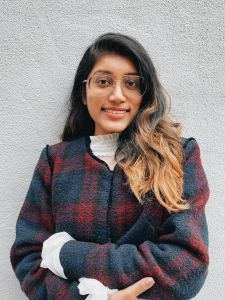
Chandanie Somwaru is an Indo-Caribbean woman who was born and raised in Queens, New York. Her writing has been published in Angime, Honey Literary, Posit, Solstice, SWWIM, The Margins, VIDA Review, and elsewhere. In 2021, Somwaru published a chapbook with Ghostbird Press titled Urgent \\ Where The Mind Goes \\ Scattered. She received an MFA in poetry from Queens College and is currently a Ph.D. student at the University of Hawaiʻi at Mānoa.
 MĀNOA
MĀNOA 
Leave a comment