Book Review by Alia Jeraj
In 1970 biologist Robert Payne released an album, “Songs of the Humpback Whale,” recorded underwater. The album, featuring vocalizations of humpback whales, quickly went platinum as the sounds, perceived as songs, captured people’s hearts and imaginations around the world, kickstarting a global movement to “Save the Whales.”

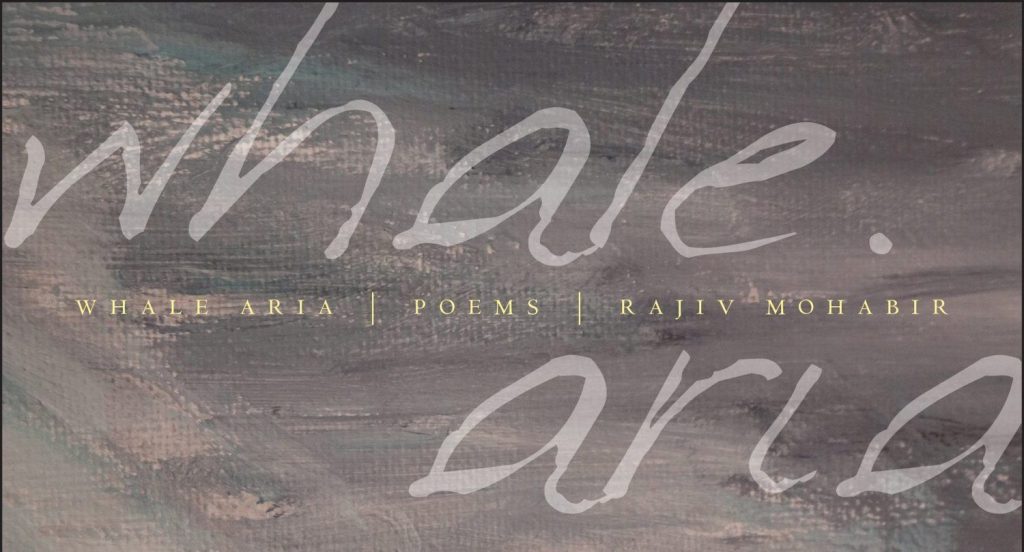
Rajiv Mohabir takes on this study in Whale Aria, a collection of poetry published in 2023 by Four Way Books. Over half a century after Payne’s album, whale songs continue to entrance. Scientists have spent countless hours trying to understand their form and composition, and looking for meaning. Mohabir’s fourth book of poetry, the collection draws parallels between whale and human experiences, blurring the boundaries between the two to look at how colonialism and imperialism impact us both, especially in the sounds we make, and the ways in which we relate to one another.
Perhaps we should see Whale Aria as an extension of “Songs of the Humpback Whale,” giving words to the whale song, revealing their joys and their pains, all the while connecting whale experiences to human ones, particularly to humans who also experience the pain and violence of colonialism and imperialism. Within Whale Aria are three other arias: “Immigrant Aria,” “Orient Aria,” and “Ghost Aria.” All are written in tercets with every other line indented: a form created by Mohabir inspired by the structure of humpback whale songs. By placing the stories of immigrants, the exotic, and the lost onto the form of globally-loved whale songs, Mohabir makes legible the violence done to all of us.

The collection begins with “Dominion,” and an epigraph from Genesis, which grants man “dominion over…every creeping thing that creepeth upon the earth.” In this opening Mohabir makes clear the collection’s intention: it is not only an exploration of the beauty of whale song, but of the violence the songs and their singers face. “Dominion” is followed by “Boy with Baleen for Teeth,” showing us that the fate of whales is interconnected with the fate of humans, particularly those living at the margins, in Brown and Black and queer bodies. Separated into nine sections, Whale Aria takes readers through some of the many violences of colonialism, from changing our bodies, to losing our languages, to physical violence.
One of the violences both whales and colonized peoples face is the way we are rendered beautiful only in death, indeed rendered at all only to be killed. “Why must we slay the sea- / beast to recognize its beauty?” Mohabir asks (in “Dissecting the Tay Whale”), noting that for our beauty to be seen we must first be conquered. The following poem asserts in its first part, “America, you map my cosmos to bomb it”—our very being seen is our demise (“Sound Navigation and Ranging”).
Throughout Whale Aria Mohabir returns to the violence caused by the US military and, particularly, the navy. How ironic that while a biologist created the album of humpback whale songs, the first recordings were made by a US naval engineer, listening for submarines during the Cold War. The institution that made whale songs legible to the average land-dwelling person (people well-acquainted with the ocean have of course been listening to whale songs for millennia) also kills them.
This summer, RIMPAC returns to Hawai‘i in a weeks-long display of international naval power. Environmentalists have long voiced their concerns over the impact of live missiles and sonar shot into the ocean, especially on cetaceans. Mohabir derisively writes, “It’s just a game, relax. It’s all empty / land, come and torpedo the coral, come / and reap the whales along the rivulets / and tributaries. Come, aggression / is healthy, is American” (“Sound Navigation and Ranging”).
I started reading Whale Aria during Act I of La Bohème, seated backstage at the Waikiki Shell, under the shadow of Lē‘ahi. Years ago, I gave up my dreams of an opera career in favor of folk songs and performance art, but was recently lured back with the opportunity to sing Puccini under the stars. In an opera, an aria is a solo piece sung to display a character’s intense emotions and vocal prowess. Whale Aria certainly showcases Mohabir’s prowess as a poet, as he uses the form of humpback whale songs to structure his lines and verses. Reading Whale Aria underscored by opera aria, I was moved to tears.
Like any good aria, Whale Aria is full of not only pain, but beauty. Even as he starts by naming the violence of the dominion of man, Mohabir ends that opening poem revealing himself an act of resistance: “I strike a candle / against ruin, against / the separation of day / and night” (“Dominion”). And, he ends the aria with the return of whales to New York City. Though the violence of noise and plastic pollution have kept whales out of the waters surrounding the city and xenophobic policies try to keep immigrants out of New York, “Behold the miracle: / what was once lost / now leaps before you” (“Why Whales are Back in New York City”). We—whales and humans both—are resilient. In Whale Aria, Mohabir helps our songs find their way to each other, insisting on our alive-ness, our being-ness, and our beauty.
Alia Jeraj (she & they) is a writer, artist, and educator living in Honolulu. She recently completed her MA in Asian Studies at the University of Hawai’i at Mānoa, researching a Shi’a sung-poetry tradition in northern India. Before starting their MA, Alia lived in the Twin Cities, MN, where their work was published in venues including: American Craft, Pollen Midwest, Twin Cities Daily Planet, and the Mill City Farmer’s Market blog.
 MĀNOA
MĀNOA 
Leave a comment