April 11, 2024
Mai Der Vang is an internationally recognized poet whose most recent book Yellow Rain (Graywolf Press, 2021) was awarded the Lenore Marshall Poetry Prize from the Academy of American Poets and an American Book Award. Yellow Rain is a work of documentary poetry that grapples with the biological chemical attacks against Hmong refugees in the 1970s. It was a finalist for the 2022 Pulitzer Prize in Poetry. Vang teaches at Fresno State in the MFA Program for Creative Writing.
Hailing from Michigan, Audrey Beaton studied Korean and English with a focus in Creative Writing at the University of Hawai’i at Mānoa. They graduated in May of 2024 and are currently applying for creative writing MFA programs. They write fiction, poetry, creative nonfiction, and critical essays. Their poetry has been published in The Broadkill Review.
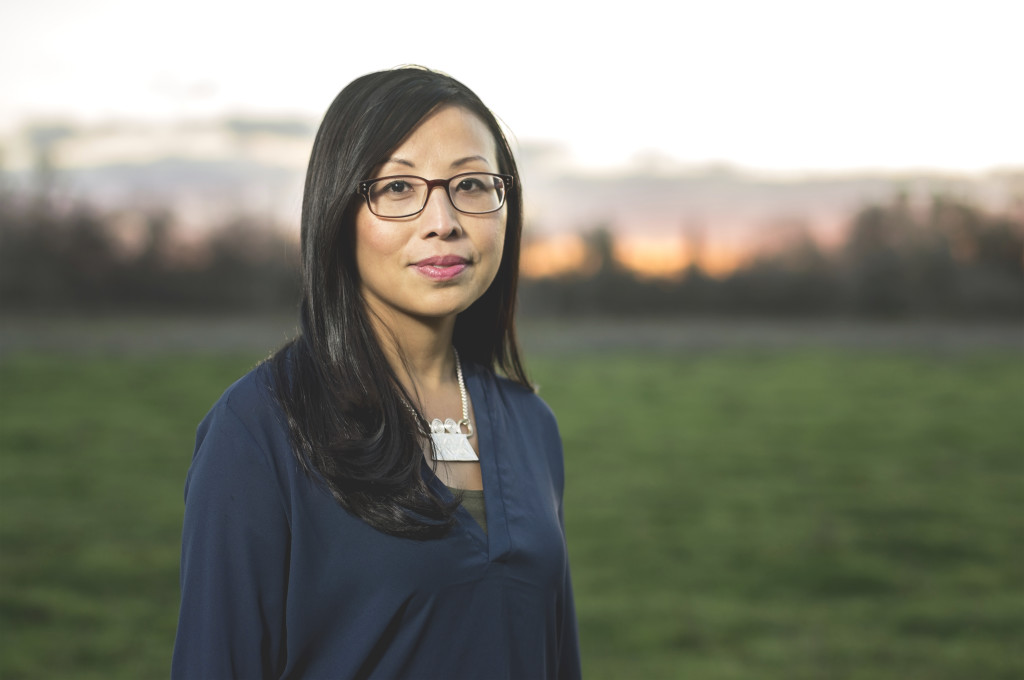
Mai Der Vang traveled to Honolulu as a featured writer for Words @ Mānoa, a literary series run by the Creative Writing Program in the English Department that welcomes visiting writers to read and conduct workshops for students at the University of Hawaiʻi at Mānoa. Our discussion was held on the University of Hawaiʻi at Mānoa’s beautiful campus.
Audrey Beaton: So, Mai Der, I’ve, of course, read both of your books— Afterland and Yellow Rain— and I’ve found myself really curious about your craft and how it differs between the two collections. I know about four years passed between publishing Afterland and Yellow Rain. I’m wondering how your writing process, your craft, or your approach to craft has changed from Afterland to Yellow Rain?
Mai Der Vang: From Afterland to Yellow Rain, there’s been a big leap for me in terms of a more deliberate move toward using documents and archival materials in my poems. That was probably the most profound change— the use of the research to help ground my poems, especially with Yellow Rain. I had to rethink how to write these poems while taking into some consideration the perspective of the audience. I was invested, I think, too, in a different way in these poems. Afterland was an opportunity to explore what I wanted to say about who I am as a daughter of Hmong refugees. With Yellow Rain, it was so much about reckoning with this bigger political history of how and why Hmong people became refugees through issues like yellow rain.
Beaton: Going off of that, how does engaging with research inform your poetry? As you are a documentary poet, do your poems sort of spring from the documents or do you have an idea of what you’re looking for in the documents for a poem that you’re writing?
Vang: The documents were guideposts for me to think about this topic of yellow rain because I was learning so much about yellow rain in the process of writing the book. Sometimes I would find something in a document that would inspire me and I would tell myself, “This is a poem.” Or, “this is a visual that could become part of a background or a watermark to a poem.” It was enriching to move outside of poetry to explore other materials that could shape my poems. I didn’t feel like I needed to be surrounded by poems to write poems. And I believe that, too, as a writer, it can be incredibly meaningful to create on an interdisciplinary level, to ground your work in other fields of study and arrive at poems you hadn’t initially considered. I was lucky to be able to do that with Yellow Rain—to teach myself new things about writing and poetry by examining other disciplines.
Beaton: That is so cool. Speaking of the visual parts, I myself am not a very visual person. Truthfully, understanding visual art is a challenge for me, so I spent a lot of time grappling with the visual aspects of Yellow Rain and engaging in conversation with others in order to gain a better understanding of it. I was wondering how exactly did you go about creating these visuals? How did they come to mind for you? Was it sort of an implosion of the documents you had? And what about the finished pieces on the pages of Yellow Rain tell you that they’re finished?
Vang: The visuals are interesting because they appear—especially the compositions—every so often within the collection. And then there are poems with visuals, too, as a background or watermark. I used to be a graphic designer, and that experience helped me think about the spacing and positioning of text and objects. How the eyes move across the page, where we might first focus our attention, what new meaning can be created by simply placing words nearer or further away from other words. In attempting to compose text visually on a page, I tried a lot of different things. The poems exist in the collection, but there was so much to them and I felt them to be overwhelming. The visuals became a moment to digest the text in a different way, to step away from looking at the text as text and to instead look at them visually while giving the reader a chance to breathe.
Beaton: Okay, I have a question about white space that sort of follows this topic well. I’m curious if the white space you use throughout the collection works similarly to these visual aspects as breathing space?
Vang: I think it does. It slows the pacing in a way that might allow a reader to feel and process the poem differently than if those spaces weren’t there. It allows the eye and the reading of the poem to take its time. Through the use of these spaces, or visual pauses, I could take something from a document and put it on a page, and then I could take something else from another document and also configure it on the same page. The act of having those statements together on the same page created a new statement. This allowed me to use language and spacing as a way to linguistically and visually restructure the narrative of yellow rain.
Beaton: Yes, that was one thing that really engaged me in a way that was like, “Oh, I don’t know what’s going on here exactly, but I’m going to dig into it and try to gain an understanding.” It was such an integral part of the book that I really felt the need to sit with the visual aspects and spend time with them.
Vang: And even if the visuals don’t make sense immediately, it’s okay. But also, I was so inundated with documents, I think I just wanted to show my readers what I was finding. I wanted to simply say, “Look, this was what I came across. What do you think?” That was also part of my intent in offering the compositions, to allow readers to make their own assessment.
Beaton: I also think there’s such value in not necessarily demanding that we make sense of senseless actions. In the parts that I didn’t understand, I was thinking, “Maybe it’s okay that I don’t understand because the actions being reported on are unexplainable, unjustifiable.”
Beaton: I’m also curious as to how place informs your writing. Here in Hawaiʻi, as learners and people who live on this land, we do our best to let the land guide us and take care of it as it takes care of us within our work. So I’m intrigued, because you are a child of Hmong refugees, and both Afterland and Yellow Rain deal with the trauma of forced relocation, what does place do for your writing and for your work?
Vang: I think about that a lot—landscapes, place, and geography. Because I was born in this country right around the time my parents were resettled here, I have no actual, physical, tangible memories of what home was like for them. I can only imagine it, I can try to envision it, I can hear about it through stories, but for me, it’s a memory that I have that isn’t a memory at all. These mountains, this homeland, these highlands, this village— these are all things that exist and existed in real life, but they also exist in my imagination, too. I have to reckon with the fact that I wasn’t there. And if I did go there, to Laos or to see these mountains, it wouldn’t be the same as how my parents experienced it or lived it. These are spaces that I will never physically be able to access so I’ve always felt orphaned by the idea of place, like I don’t belong anywhere, and I’m okay with that. As a poet, I’ve come to find my own space in poetry. Poetry becomes my homeland. Poetry becomes the space I can visit and know its hills, its valleys, its vast lakes and mountains. For me, poetry is place.
Beaton: I love that idea. Making a homeland out of poetry. I’m afraid the next question will steer us away from that beautiful concept, but I am intrigued a bit about the specifics of your craft. I’ve noticed that in a lot of your poetry—especially in Afterland— you use couplets quite a lot. Is there something that draws you to couplets? Do they do something for your work?
Vang: I find that I’ve used couplets as a way to allow lines to be together, but still have space around them. The couplet has allowed me to do that best. The couplet gives space but also connects. I haven’t used the couplet in a lot of recent poems, but every now and then, when I look back at the couplets I wrote in my first book, I feel content with them there.
Beaton: As a reader, they definitely gave me the feeling—especially in Afterland because there are so many themes of being alone but also being surrounded by those who came before you— they gave me a feeling of companionship, but also some solitariness because they do sort of exist in these little spaces by themselves. I saw them working in so many ways, so I was interested in your perspective on the couplet as a writer.
Vang: Yes, that’s a really great observation—together and also alone. I agree.
Beaton: Speaking of voice, as a student, I’m currently studying polyphonic poetry—poetry that engages with multiple voices and poems that allow for multiple voices in a space to agree, to argue, to speak over each other, or to join one another in a sort of chorus. Poems throughout Afterland and Yellow Rain are intensely polyphonic. So how do you as a writer balance the multitude of voices in a poem, and how do you feel you yourself as a speaker fit into that?
Vang: I’ve never entirely thought of my poems as being polyphonic so it’s interesting you say that. Behind the polyphonic poem, or a work that engages multiple voices, I feel there’s a deep reverence and patience a poet has to have in order to allow a multitude of different voices or utterances to enter the poem. It requires that the poet is able to let go of the need to control the poem in order to let those voices be there. It shows restraint and it shows a type of care from the writer to be able to say, “I am going to give space on my page to these multiple voices.” I don’t think it’s necessarily easy to do at all, and there are moments, too, when I’ve said to myself after having just written something, “Where did that come from?” Or, “Who wrote that?” I’m still working through my own approaches to polyphonics, but I think I’ve also learned to intuitively allow those moments to happen in a poem without the need to explain or without the need to force a consistency in those voices. I think poets do a lot of channeling, too, drawing from some unknown part of themselves or ancestral voices elsewhere. It takes willingness to let go of control, to allow multiple voices and then to listen carefully as the poem is channeled through you and onto the page.
Beaton: As a student, I’m learning how to let go of that need to control my work. It’s definitely difficult. I have this deep desire to hold my work close to me and make it mine.
Vang: And it’s okay to feel that, too. We often feel vulnerable when we write something because we might be sharing something personal and we want for our readers to understand what we’re saying. But when we can let go of that need to force the reader to understand, then the poem begins to happen.
Beaton: Speaking of channeling, I’m curious about something you said at your reading yesterday about Hmong people “only existing in the archive,” and not having much of a voice in the public sphere. And I wonder how you write as a representative of Hmong people and culture? And as you write, does that weigh on you?
Vang: Yeah, it’s interesting because there’s this thing about being considered a “Hmong poet.” By virtue of that, people instinctively assume that I’m writing on behalf of all Hmong people. I have to remind audiences that I am just one story within the larger community, within the Hmong diaspora, you know? My family is just one story of many, many stories. But even as that may be, there’s also a collective history that, for me, as a Hmong writer, I’m proud to share with other Hmong people. I think that’s where I feel a deep sense of gratitude and community, when I am able to come into a space where I am around other Hmong people, and immediately I feel a kinship, I feel an affinity, like I’ve come home to a family member. I really am grateful for that— for those feelings of kinship when I meet a Hmong person, and we share a collective history. And then, on the other hand, like I said, I’m grateful for the unique stories that every Hmong person has, too, about their experiences, their own journey to get through the war, their own family’s stories.
Beaton: Yes, absolutely. I only have one question left, and it’s actually a question that a fellow editorial intern at Mānoa Journal came up with. So, you’re in academia as well, you’re a professor. What advice do you have to become a better literary citizen? How do you foster community as both a writer and a reader? What does being a good literary citizen mean to you?
Vang: Being a good literary citizen can mean a lot of things. It can mean things that are more involved, like supporting writers by writing blurbs and citations for their books, doing reviews on their books. Or it can be something as simple as going to events that support them. Or just reading poetry or other writing. It depends on a person’s capacity and them asking themselves, “Where can I contribute?” and “How can I support and be part of building a thriving literary space in my own community?” I love this question because it’s not a question I ever get asked, really, but it’s so important because as a writer, we need readers. We need people to support the larger ecosystem of literature in this country. And that can include anything from buying a book, supporting indie bookstores in your community, to—like I said— reading and then writing reviews for books, editing for journals, and even sending your work to literary journals can be a way of demonstrating your literary citizenship. Another good piece of advice I’ve heard, too, is to support your local library, and to put in requests for your library to order more poetry books for their collection, especially if it’s a collection that feels outdated.
Beaton: Yes, absolutely, supporting your local library is such a good way to get involved in your local literary community. Well, Mai Der, thank you so much for your time and your thoughtful responses. It’s been a pleasure to talk to you and I so appreciate your willingness to sit down with me.
Vang: Thanks again for chatting with me!
 MĀNOA
MĀNOA 
Leave a comment